8 Best Borescopes and Inspection Cameras of 2026: Stay-Ready Tools for Diagnosis

Find the right borescope for engine, wall, pipe, and HVAC checks — with clear visual diagnosis and reliable build quality.

Most inspection camera listings lean heavily on pixel counts and waterproof ratings, but the real test happens when the probe is bent around a cylinder head or pushed deep into a wall cavity.

The common breakdown point is the articulation mechanism, the phone connection, or the cable's steering feel. A borescope is only useful when the image stays clear and the probe goes where you point it.

This guide focuses on tools that hold up in actual engine bays, HVAC ducts, and plumbing chases. The picks balance reach, articulation, recording ability, and screen quality so you get a clear answer on the first pass.

1

Best Overall

Teslong TD450S Articulating

91 /100
Studio Score High Confidence

Key details

Head Type
Two-way articulating
Cable Length
5 ft
Probe Diameter
—
Water Resistance
IP67
Check Price on Amazon

The Teslong TD450S puts a two-way articulating probe, a 4.5-inch IPS screen, 1080p video and photo capture, and a 2-year warranty in one standalone kit. The forward lens resolves hairline cracks cleanly enough to distinguish a cylinder-wall fracture from a casting mark, and the LED ring lights deep cavities without blowing out the image. Build quality matches the kind of tool you expect to find in a working shop rather than in a drawer of impulse buys.

The joystick steers the tip in two directions while the semi-rigid gooseneck holds whatever curve you set, so one person can inspect behind valve covers, inside HVAC plenums, and along wall studs without a helper stabilizing the cable. Photos and video save to a 32GB card, leaving a visual record for a customer, a supervisor, or your own repair notes. That combination of steering plus recording makes the scope useful for diagnosis that ends with a decision, not just a guess.

The buyer profile is a mechanic, HVAC tech, or homeowner who wants a self-contained scope without phone pairing. The 5-foot cable is the boundary: it reaches across an engine bay or into a wall cavity, but long drain cleanouts are outside its range. For sewer-depth work, a long-reach dual-lens model is the better fit. Within that boundary, the TD450S suits brake-line checks, valve inspections, wall outlets, and condenser coils without the setup delay of a phone app.

At this mid-range price, the package removes the two frustrations that dominate cheaper scopes: fiddly phone connections and weak lighting. The 32GB card is included, and the 2-year warranty covers the electronics, so the listed price is close to the actual cost of ownership. Use cases span automotive, HVAC, and home tasks, and a couple of paid diagnostic calls can cover the cost of the unit. That value position is why the TD450S lands as the top pick in this category rather than a budget experiment.

This is a single-lens scope, so side-wall views come from the articulating head rather than a second camera. That keeps the probe slim and the control simple, and it is a fair trade for buyers who want one self-contained tool rather than a phone-connected gadget with lens switching. The two-way joystick covers the angles that come up in automotive and HVAC work. The 4.5-inch screen gives enough room to see the probe tip and the surrounding area at once, something a small phone display makes harder.

💡 Move the joystick with steady pressure instead of forcing it past the stop; that keeps the articulation precise longer.

Pros

  • Build quality holds up across repeated shop and homeowner jobs.
  • Image clarity exposes cracks and engine damage without pulling surrounding parts apart.
  • Photo and video capture documents findings for warranty claims and customer reports.
  • The kit pays for itself after a handful of diagnostic uses.
  • Two-way joystick steering reaches into tight corners around valve covers and brake lines.

Cons

  • Probe lens fogging can occur after coolant or solvent exposure, so fluid-heavy jobs call for tip cleanup.
  • Articulation control can develop slack in heavily used units, making fine positioning less precise.
Our verdict

The TD450S is the standalone articulating scope for buyers who want to inspect, record, and move on without pairing a phone.

Check Latest Price
2

Best Long-Reach All-Rounder

DEPSTECH DS300 Dual-Lens

91 /100
Studio Score High Confidence

Key details

Head Type
Dual front/side
Cable Length
16.5 ft
Probe Diameter
—
Water Resistance
IP67
Check Price on Amazon

DEPSTECH's DS300 pairs a 16.5-foot semi-rigid cable with a 4.3-inch IPS screen and 1080p photo/video recording, giving you a standalone long-reach scope that does not depend on a phone. The dual front and side lenses let you switch between straight-ahead and sidewall views without rotating the camera head, which is useful for wall cavities, drain pipes, and ductwork.

The built-in screen is large enough to read on-site, and the roughly four-hour battery covers a day of intermittent checks. Recording to a microSD card produces photos and clips you can hand to a homeowner or include in a service report. The side lens earns its keep when you need to inspect a pipe interior or a wall opening without fighting to get the tip into the right angle.

This is for homeowners and tradespeople who prioritize range and dual viewing angles over independent tip steering. Plumbers and HVAC techs can push the semi-rigid cable through long drain and duct runs, and DIYers can chase wiring or wall leaks without a second person holding a phone. The cable is stiff around tight-radius bends, so allow extra effort when you need a sharp curve close to the camera. Occasional cloudy-lens or no-signal behavior can appear in individual units, so a quick bench test before relying on it is a reasonable habit.

Pros

  • Strong build and image quality for the money.
  • Works across household, plumbing, HVAC, and vehicle checks.
  • Clear picture and video help spot cracks, blockages, and wiring issues.
  • Easy to use with simple lens switching and recording.

Cons

  • Semi-rigid cable resists tight-radius bends, so it suits fairly straight runs best.
  • Individual units can show cloudy front-lens or no-signal behavior after months of use.
Our verdict

This is the long-reach dual-lens standalone to start with when your work runs past 5 feet and you want a built-in screen and recording.

Check Latest Price
3

Best for Tight Engine Diagnostics

FOXWELL Y400 Articulat.

89 /100
Studio Score Strong Evidence

Key details

Head Type
Two-way articulating
Cable Length
5 ft
Probe Diameter
0.24 in
Water Resistance
IP67
Check Price on Amazon

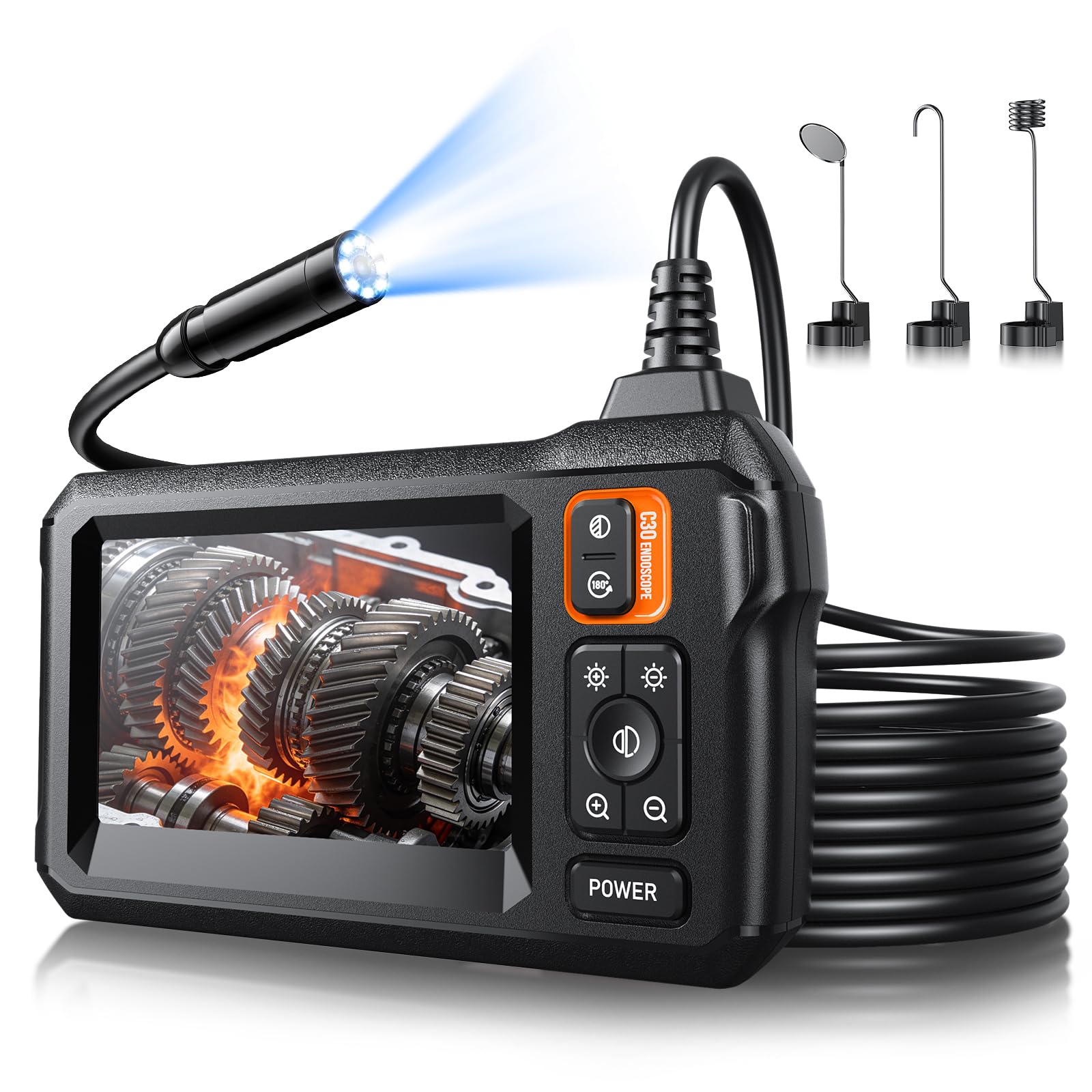
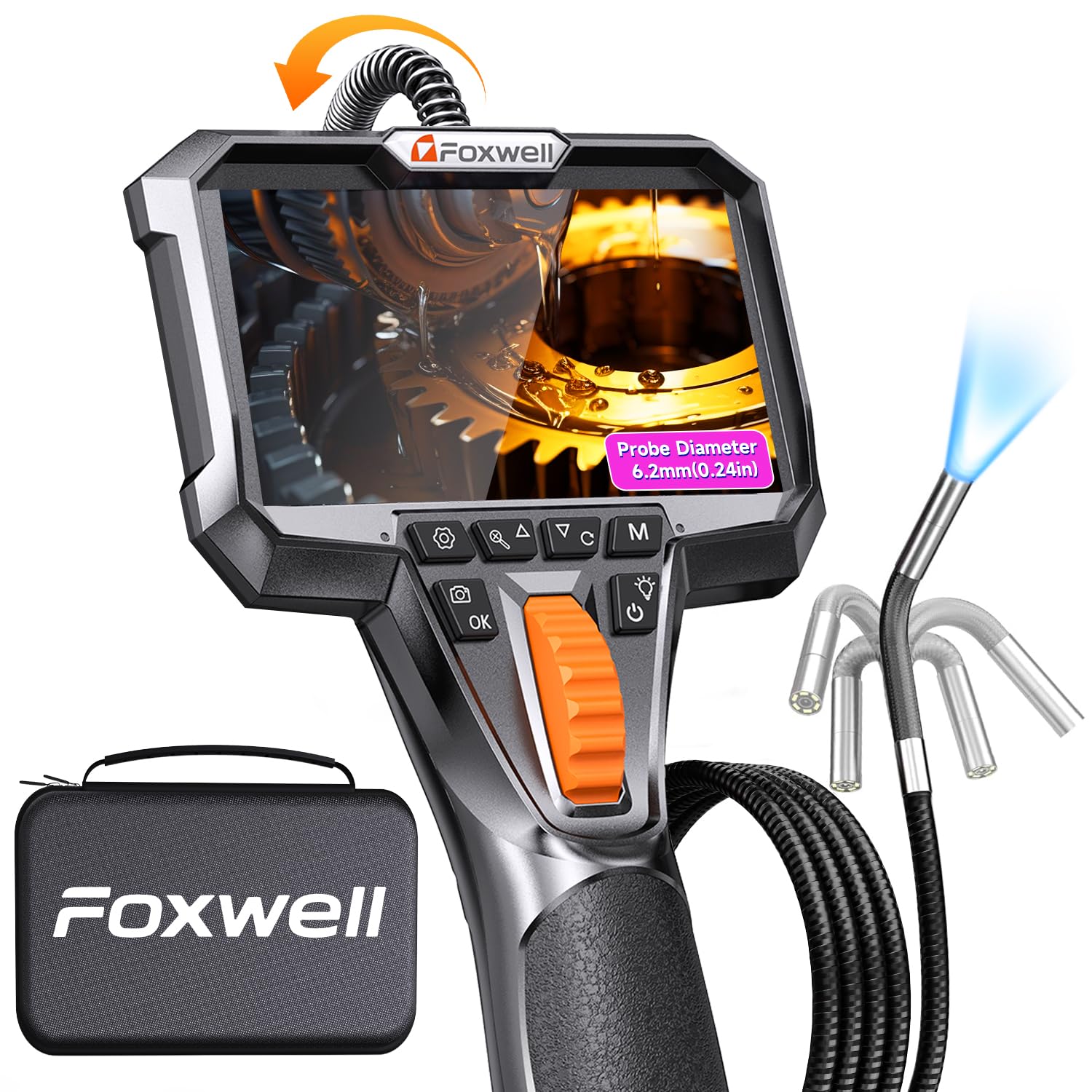
The 0.24-inch articulated probe reaches into spaces a fixed-head camera cannot, and the 220° two-way steering keeps the lens aimed at valves, pistons, and hidden gaskets.

Images come through with enough sharpness to read casting marks and corrosion on the 4.3-inch IPS screen. The joystick adjusts the head angle in small increments, so the probe can be walked around a corner without dragging the cable. Battery life covers a full diagnostic session, and the IP67 probe tolerates coolant spray and damp pipes.

The bent-head orientation takes practice because the camera angle shifts with the articulation. That is a learning curve, not a limitation that rules the scope out for close-in work.

Buyers working on engine internals, HVAC components, or plumbing fixtures with tight bends should treat the Y400 as a precision tool first and a long-reach scope second. The 5 ft semi-rigid cable is enough for a cylinder head or a short drain trap, but wall cavities and full drain runs belong to the longer dual-lens models. The slim head keeps working in spaces a gloved hand cannot reach, which makes the cable length a fair trade for the access it provides.

💡 Rotate the probe slowly while the head is bent to build a mental map of the image direction.

Pros

  • The display makes it easy to tell rust from grease, with enough clarity for diagnostic decisions on the spot.
  • Build quality feels more solid than the price tier suggests, with a crisp joystick and sturdy cable sleeve.
  • Priced below comparable dealer-level kits while keeping the slim probe, onboard storage, and long battery.

Cons

  • Video capture is capped at 720p, which is acceptable for a repair log but not for high-detail 1080p documentation.
Our verdict

When the access point is measured in inches, the Y400's slim probe and 220° steering turn a blind reach into a visual one.

Check Latest Price
4

Best Budget Standalone With Long Cable

MugEasy 4.3" Endoscope

90 /100
Studio Score High Confidence

Key details

Head Type
Forward
Cable Length
16.5 ft
Probe Diameter
—
Water Resistance
IP67
Check Price on Amazon

MugEasy's 4.3-inch IPS screen and 16.5-foot semi-rigid cable make it the simple standalone option for DIYers who want to see inside a wall, pipe, or engine bay without pairing a phone. The display stays bright enough to read in a dim crawlspace, and the eight adjustable LEDs put usable light wherever the tip is aimed.

The intended buyer is someone doing a visual check, not assembling a maintenance report. Live viewing can confirm a clogged drain, loose wiring, or a cracked gasket, and the long cable reaches places that would otherwise require cutting or disassembly. Home projects and light automotive work fit well; anyone who needs documented evidence for a contractor should look at the dual-lens standalone in this set.

In open runs like cleanouts and wall cavities, the semi-rigid shaft pushes smoothly and holds a curve you set. Tight elbows and deeper engine cavities take patience and a few extra attempts, but the LED ring keeps the target visible throughout.

Battery life holds up through back-to-back inspections, and the controls are predictable enough that attention stays on the probe instead of the menu. For the price, it is a low-friction complement to a toolbox full of bigger tools.

Pros

  • Built-in 4.3-inch IPS screen gives a clear live image with no phone pairing or app setup.
  • 16.5-foot semi-rigid cable reaches wall cavities, drain runs, and engine bays.
  • Eight adjustable LEDs produce enough light for dark and confined spaces.
  • Battery life is enough for multi-stop home projects and vehicle checks.

Cons

  • No articulation or side lens, so angled views require manually working the cable into position.
  • No photo or video capture, so findings live only on the screen and cannot be shared as evidence.
Our verdict

For a budget-priced standalone with a long semi-rigid cable and a clear built-in screen, this is the live-inspection tool for home and light automotive work.

Check Latest Price
5

Best Articulating Value

DXZtoz AGC430N Articulat.

91 /100
Studio Score High Confidence

Key details

Head Type
Two-way articulating
Cable Length
5.5 ft
Probe Diameter
—
Water Resistance
IP67
Check Price on Amazon

The DXZtoz AGC430N brings 220° two-way articulation, 1080p recording, 8x zoom, and a 32GB card to a lower price than the top pick. The 4.3-inch screen and 5.5-foot semi-rigid cable put it in engine-bay and wall-cavity territory, where steering matters more than raw reach.

Image quality is the standout feature. Fine details on gasket surfaces and cylinder walls come through clearly, and the light handles dark cavities within the cable's reach. The joystick responds smoothly when guiding the head around valves and behind brackets, and the standalone design avoids phone-pairing headaches. Controls are simple enough for a first-time user to get usable footage within minutes. The included 8x zoom and 32GB card add practical value for capturing photos or video without extra purchases.

This is the scope for a mechanic or DIYer who wants steering without paying the premium for the top pick and without relying on a phone app. The articulation mechanism carries the main durability risk: it can wear out after months of regular use, so it suits moderate weekly work rather than continuous daily use. If the articulation head will spend all day moving, the stronger warranty and more established control hardware of the top pick are worth the extra cost.

💡 Ease off the joystick at full deflection so the articulation head stays precise longer.

Pros

  • Articulating head reaches valves and cylinders that forward-only scopes can't see around.
  • Images come through sharp enough to read part numbers and inspect gasket surfaces.
  • 8x zoom and a 32GB card give it a value edge over other articulating standalone scopes.
  • Screen controls are simple enough for first-time users to capture footage quickly.

Cons

  • The 5.5-foot cable covers engine bays and tight corners but not long plumbing chases.
  • The articulation control can become loose or unresponsive after months of frequent use.
Our verdict

The 8x zoom and included card make this the value pick for buyers who need articulation on a budget.

Check Latest Price
6

Long-Reach Teslong

Teslong NTS300 Dual-Lens

92 /100
Studio Score High Confidence

Key details

Head Type
Dual front/side
Cable Length
16.5 ft
Probe Diameter
—
Water Resistance
IP67
Check Price on Amazon

The NTS300 pairs a 5-inch IPS screen with a 16.5-foot semi-rigid cable, giving you a long-reach standalone viewer for wall cavities, drains, and engine bays. Both lenses deliver clear images, and the large display keeps the live view readable without a phone. It sits in the premium tier, and the DS300 sibling records 1080p for less money, so you are paying for the 5-inch screen and longer Teslong reach rather than the 720p video capture. The cable gets harder to steer when fully extended, which slows long pipe runs. For live diagnosis where a clear, large image and extended reach matter, the dual-lens design holds up well.

Pros

  • 5-inch IPS screen gives a clear live view for wall, drain, and engine inspection without needing a phone.
  • Front and side lenses both produce sharp images, so you can switch angles without moving the probe.
  • 16.5-foot semi-rigid cable reaches farther than most handheld scopes, covering long wall and plumbing runs.

Cons

  • Battery operation can vary between units, so verify charge-holding before a long job.
  • In tight spaces that need a bending probe, the side lens substitutes for articulation on a semi-rigid cable.
Our verdict

It suits buyers who want a large built-in screen and the extra reach of a 16.5-foot cable over phone-dependent models.

Check Latest Price
7

Smartphone Budget

Kinpthy W400-B15

86 /100
Studio Score Strong Evidence

Key details

Head Type
Forward
Cable Length
16.4 ft
Probe Diameter
7.9 mm
Water Resistance
IP67
Check Price on Amazon

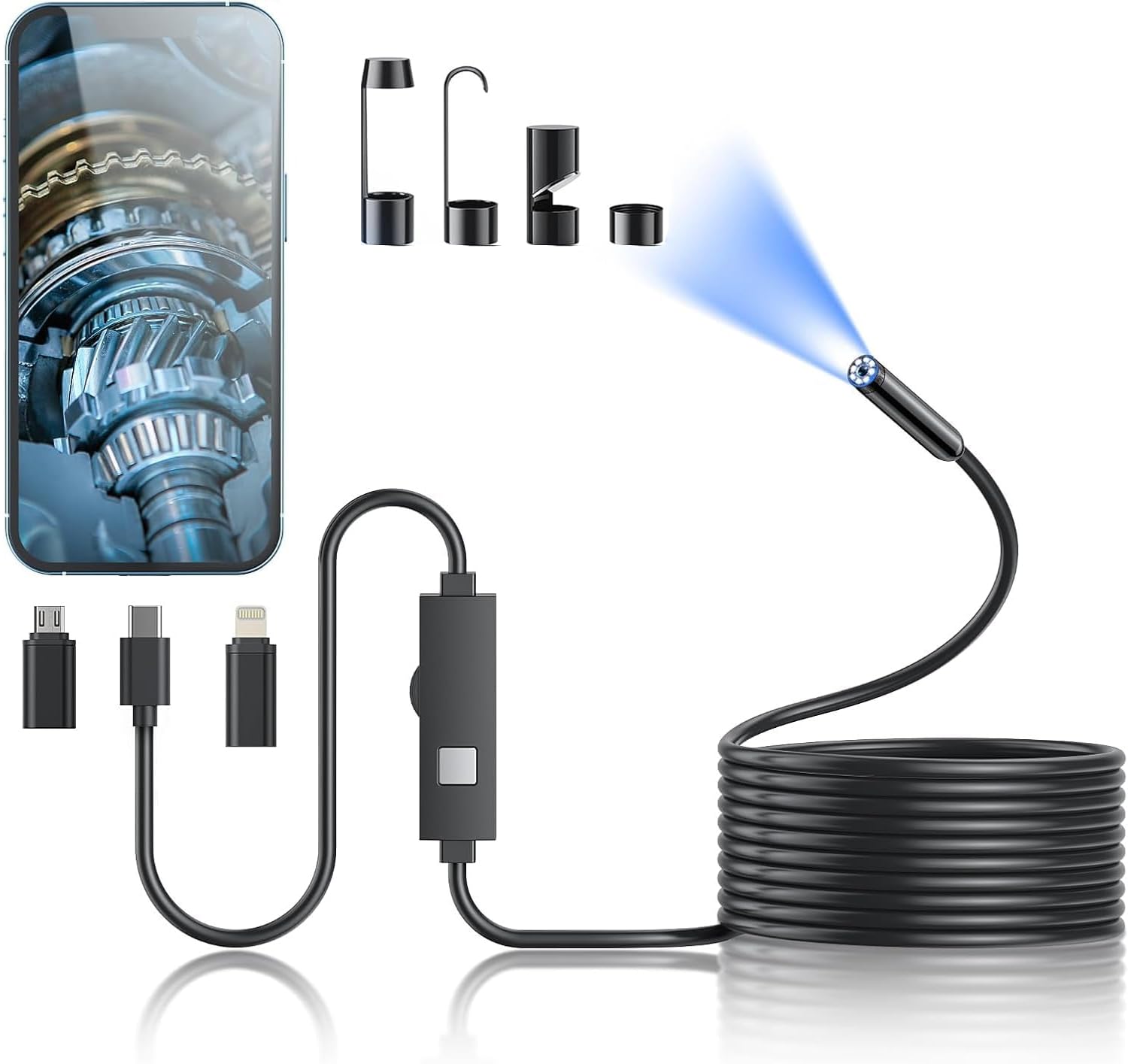
Kinpthy's W400-B15 gives phone-first buyers a long 16.4-foot semi-rigid cable, a small-diameter probe for tight spaces, and image clarity that works for engine and wall checks once the app connects. The catch is the connection itself: app behavior varies from phone to phone, so an unsupported device may not get a stable link. LED output is adequate for close-range inspection but falls off beyond a few inches, so larger cavities need extra light. For a phone-first DIYer on a budget, that tradeoff is acceptable, but a multi-user shop should choose a standalone-screen model.

Pros

  • Clear close-up detail for engine and wall checks once the app connects.
  • Semi-rigid 16.4-foot cable reaches deep into cavities and keeps the probe steady.
  • Budget-friendly way to use the phone you already carry for inspections.

Cons

  • Lighting only covers close-range work, so larger cavities may need a separate light.
  • Phone and app compatibility varies by device, so a stable connection is not guaranteed.
Our verdict

This scope fits a phone-first DIYer on a budget who will confirm app compatibility before buying. Anyone needing one tool that works predictably across multiple phones should choose a standalone-screen model.

Check Latest Price
8

4-Way Articulation

Ralcam F606BD-MAX

90 /100
Studio Score High Confidence

Key details

Head Type
4-way 360°
Cable Length
5 ft
Probe Diameter
0.25 in
Water Resistance
IP67
Check Price on Amazon

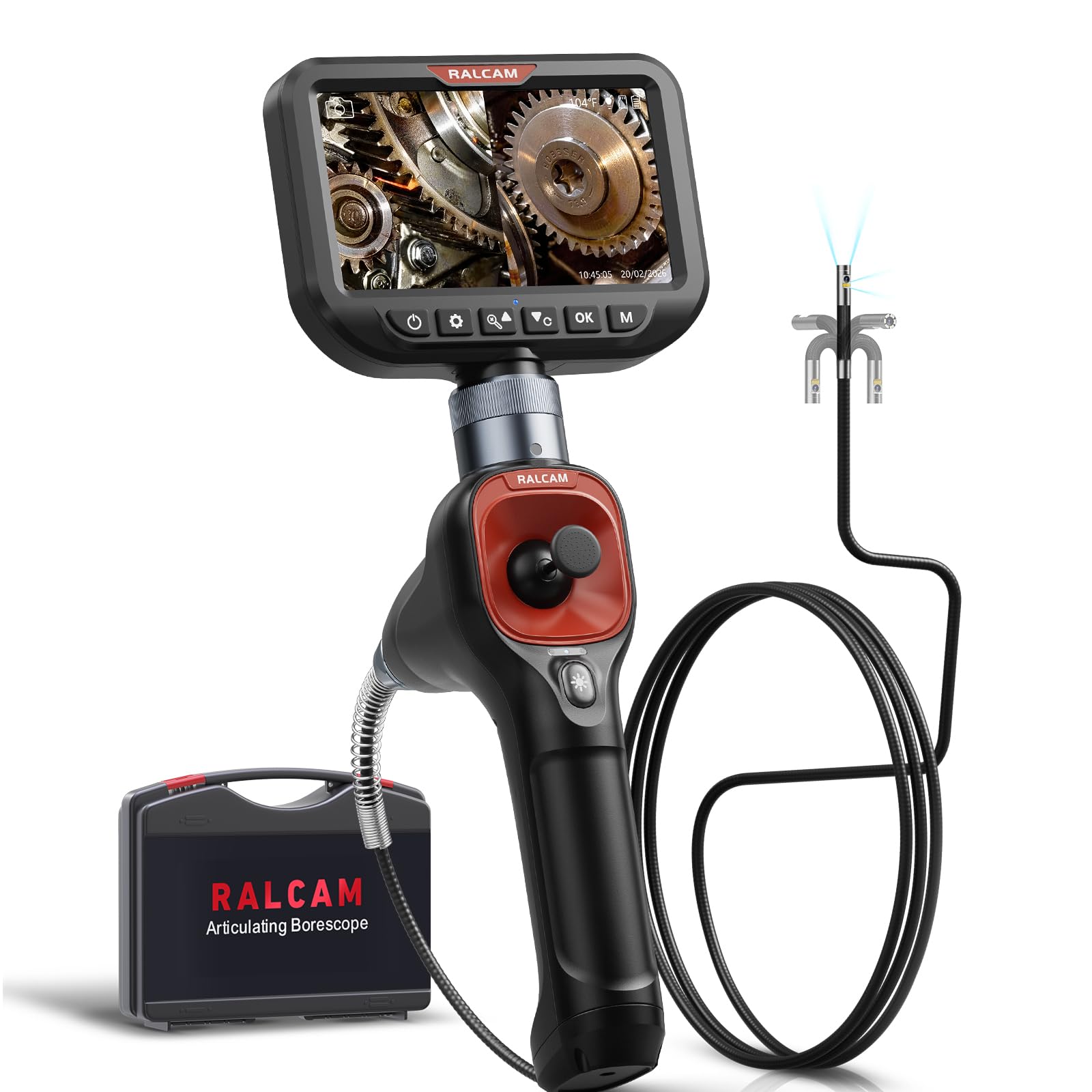
The Ralcam F606BD-MAX is the only 4-way 360° articulating borescope in this lineup; the joystick steering bends the tip in any direction without moving the cable, making it a precision tool for tight engine and wall-cavity work. Dual front/side lenses, 1080p recording, a replaceable battery, and an IP67-rated probe form a complete kit for professionals who need maximum maneuverability. It adds a second steering axis over the slimmer articulating option in this set, with a premium price to match. The listing's screen-size discrepancy (5-inch bullet vs 4.3-inch detail) needs confirmation before purchase, which keeps this in the specialist category rather than the lead.

Pros

  • The only 4-way 360° joystick steering in the set lets the tip bend in any direction without moving the cable.
  • Dual front/side lenses provide a forward view and a lateral view from the same probe.
  • Replaceable battery, 1080p recording, and IP67 waterproofing support extended inspections in wet areas.

Cons

  • The listing's display spec is inconsistent between a 5-inch bullet and a 4.3-inch detail, so confirm before ordering.
  • The 5-foot semi-rigid cable limits long drain runs and wall chases, which need greater reach.
Our verdict

For early adopters or professionals whose priority is four-way steering in close quarters, this is the only scope in the set that delivers that capability. It fills the specialist slot when the job demands maximum maneuverability.

Check Latest Price

How to Choose

Standalone Screen vs Phone App

A built-in screen removes the phone compatibility lottery. Plug in, power on, and the image is ready without hunting for an app or fighting permissions.

Phone-connected scopes are cheaper and use a larger display, but the connection quality varies with the phone's USB standard and app version. If you need a tool you can hand to a coworker without setup friction, a standalone screen is the safer path.

Cable Length and Steering

Cable length decides what you can actually reach. A 5-foot articulating probe covers engine bays and wall cavities near the surface, while a 16-foot semi-rigid cable reaches down drains and through ceiling chases.

Semi-rigid cables have a trade-off: stiffer cables push farther but resist tight bends, while softer cables follow curves but can flop inside a pipe. Match the cable stiffness to the typical path you need to navigate.

Articulation vs Dual Lens

Articulation lets you steer the tip up, down, and around obstacles, which is essential for looking behind valves or inside cylinders. Dual-lens scopes instead give you an instant side view without moving the probe, which is faster for wall cavities and pipe junctions.

The hidden trade-off is durability. Articulating heads are the most complex mechanical part on a borescope, and the control mechanism can loosen with heavy use. If you buy an articulating model, check the warranty and treat the joystick gently.

Photo and Video Capture

Recording capability matters when you need documented evidence for a repair estimate, insurance claim, or inspection report. Budget scopes often advertise a screen and an SD slot but still lack capture buttons.

Before buying, verify the listing explicitly states photo and video capture. Several otherwise solid budget scopes are live-view only, which is fine for a quick look but useless if you need to show a customer what you found.

Water Resistance and Probe Diameter

IP67 means the probe can survive brief immersion, but the camera lens and connector seals still need care. Treat water resistance as a safety margin, not a license to soak the tool.

Probe diameter controls where the camera fits. Slimmer 6mm probes enter spark plug holes and small drain openings, while wider 8mm probes often have better light output and image sensors. Choose the smallest probe that fits your typical access point.

Frequently Asked Questions