5 Best Travel Drone of 2026: Real Flight Time, Smooth Footage

Find the best travel drone for your next trip: steady sub-250g cameras with a gimbal, honest battery life, and controls you can trust.

Most sub-250g drone listings lead with 4K and long range, but the footage you keep from a trip is decided by two quieter specs: a mechanical gimbal and the number of batteries in the kit. A 3-axis gimbal holds the sensor steady when sea breezes push the airframe, and a spare battery is the difference between catching the last light and landing early. The drones here are chosen to make those two realities the priority.

There is also a trade-off between proven flight behavior and newer feature sets. Some models keep the experience simple and dependable; others push longer transmission, AI tracking, and vertical video but ask you to trust newer software on the road. The right call depends on whether you are a casual vacation shooter or a creator building a travel edit.

1

Best Overall Travel Drone

DJI Mini 4K

91 /100
Studio Score High Confidence

Key details

Video
4K UHD
Range & App
10 km, DJI Fly
Stabilization
3-axis gimbal
Weight & Regs
240 g
Check Price on Amazon

The Mini 4K keeps the essential drone package simple: 4K UHD video, a 3-axis gimbal, and a 240g airframe in a mid-range kit. The gimbal holds footage steady in gentle winds, and the controls are approachable enough for a first flight. Skipping the display controller, vertical shooting, and AI tracking is what keeps the price in check without compromising core flying behavior. Stable hovering and predictable response make positioning the frame easy, even when you are still learning stick control. The result is a drone that focuses on steady footage and easy flights rather than stacking modes you may never use.

First-time drone buyers and travelers who want a portable sub-250g camera without premium extras are the right match. Android users should plan to install the DJI Fly app outside Google Play, and content creators who need vertical video, AI tracking, or a built-in screen will be better served by the pricier Mini 3. Because the airframe weighs under 249g, it slides into a daypack without dominating the luggage. The 10km transmission range is more than enough for typical scenic flights, so the control link is not the bottleneck. The limited feature set is a boundary, not a flaw, once you match it to that travel scenario.

Pros

  • 4K footage and photos stay steady thanks to the 3-axis gimbal.
  • Beginner-oriented controls, stable hovering, and GPS return-to-home reduce first-flight uncertainty.
  • Cost-effective entry into a sub-250g 4K gimbal drone.

Cons

  • Real-world flight time can fall short of the 31-minute rating in wind or cold weather.
  • No obstacle sensing; open-field flying suits it best.
Our verdict

This is the top pick for travelers who want a portable 4K gimbal drone at a sensible price and can accept manual clearance in open spaces.

Check Latest Price
2

Best Travel Creator Drone

Potensic ATOM 2

90 /100
Studio Score High Confidence

Key details

Video
4K HDR, 8K stills
Range & App
10 km
Stabilization
3-axis gimbal
Weight & Regs
249 g
Check Price on Amazon

The ATOM 2 packs a 10km transmission, AI tracking, vertical shooting, and a 96-minute three-battery kit into a 249g airframe, with GPS return-home and a 3-axis gimbal covering the core travel-drone essentials. The 4K/30 HDR camera and 8K/48MP stills add serious creative range, and the fast-charging batteries remove the typical compact-drone battery limitation.

That mix makes it a strong match for content creators and tech-first travelers who want social-ready vertical video and subject tracking without stepping up in platform size. The tradeoff is a lack of obstacle sensors, so close-quarters flying needs pilot awareness, and return-to-home or app behavior can be intermittent in some units. Budget-first beginners are better served by the original ATOM, which keeps a lower entry point.

Pros

  • Build quality feels solid and the kit reads more premium than its mid-range price.
  • 4K HDR video and high-res 8K stills with a 3-axis gimbal in a sub-250g airframe.
  • AI tracking, vertical shooting, night shot, and fast-charge three-battery kit cover a lot of creator needs.

Cons

  • No obstacle sensors; close-quarters flying requires manual awareness.
  • Return-to-home or app behavior can be intermittent in some units.
Our verdict

For travel creators who want AI tracking and vertical video without moving up in weight class, this is the feature-forward pick.

Check Latest Price
3

Best for Vertical Video & Built-In Screen

DJI Mini 3

88 /100
Studio Score Strong Evidence

Key details

Video
4K HDR vertical
Range & App
10 km, DJI RC
Stabilization
3-axis gimbal
Weight & Regs
248 g
Check Price on Amazon

The DJI Mini 3 with DJI RC delivers 4K HDR with True Vertical Shooting in a 248g frame, so social-first travelers can frame vertical clips without cropping or using a phone mount. The 3-axis gimbal holds steady in moderate wind, and the built-in display on the RC controller simplifies flight setup. Image quality and build finish sit at the premium end of the sub-250g class.

This kit is for creators upgrading from basic 4K drones who want GPS return-to-home and a compact package they can carry anywhere. It is not for buyers expecting obstacle avoidance or ActiveTrack at this premium price; this is a pilot-driven camera, not a hands-off tracking unit.

💡 Activate and bind the drone and controller before a trip so software or activation quirks don't surface in the field.

Pros

  • 4K HDR with True Vertical Shooting frames social clips without cropping.
  • The DJI RC built-in display removes phone tethering and quickens flight setup.
  • The 3-axis gimbal handles moderate wind, keeping travel footage stable.

Cons

  • If vertical HDR and the RC screen aren't core to your workflow, the premium price is hard to defend.
Our verdict

For social-first travelers who want a compact sub-250g 4K gimbal drone with a screen controller, this is the premium option to bring.

Check Latest Price
4

Best Value 3-Axis Fly-More

Potensic ATOM

91 /100
Studio Score High Confidence

Key details

Video
4K/30fps
Range & App
6 km
Stabilization
3-axis gimbal
Weight & Regs
249 g
Check Price on Amazon

The Potensic ATOM pairs a 3-axis gimbal with 4K video, GPS return-home, and a three-battery kit good for 96 minutes of total flight. At a mid-range price, it is the strongest value package in this sub-250g group — especially for travelers who prioritize smooth footage over the newest transmission and AI extras.

This is the right fit for travelers who want gimbal-stabilized 4K without premium-priced DJI rates. Obstacle sensors are absent, so flight paths need manual clearance, and battery idle-drain can vary between units. Those limitations matter less for pilots who fly with visual line-of-sight and carry spare batteries.

Pros

  • Three-axis gimbal keeps 4K footage stable in travel conditions.
  • Three-battery fly-more kit adds up to 96 minutes of total flight time.
  • GPS return-home and intuitive controls make first flights manageable.

Cons

  • Battery idle-drain can vary between units; confirm charge before flying.
  • No obstacle avoidance means manual clearance is required for each flight.
Our verdict

The ATOM is the value pick for travelers who want gimbal-smooth 4K and spare batteries without the premium-priced extras.

Check Latest Price
5

Best Beginner Fly-More Kit

Ruko U11MINI

88 /100
Studio Score Strong Evidence

Key details

Video
4K, 8K stills
Range & App
20,000 ft
Stabilization
3-axis gimbal, EIS
Weight & Regs
248 g
Check Price on Amazon

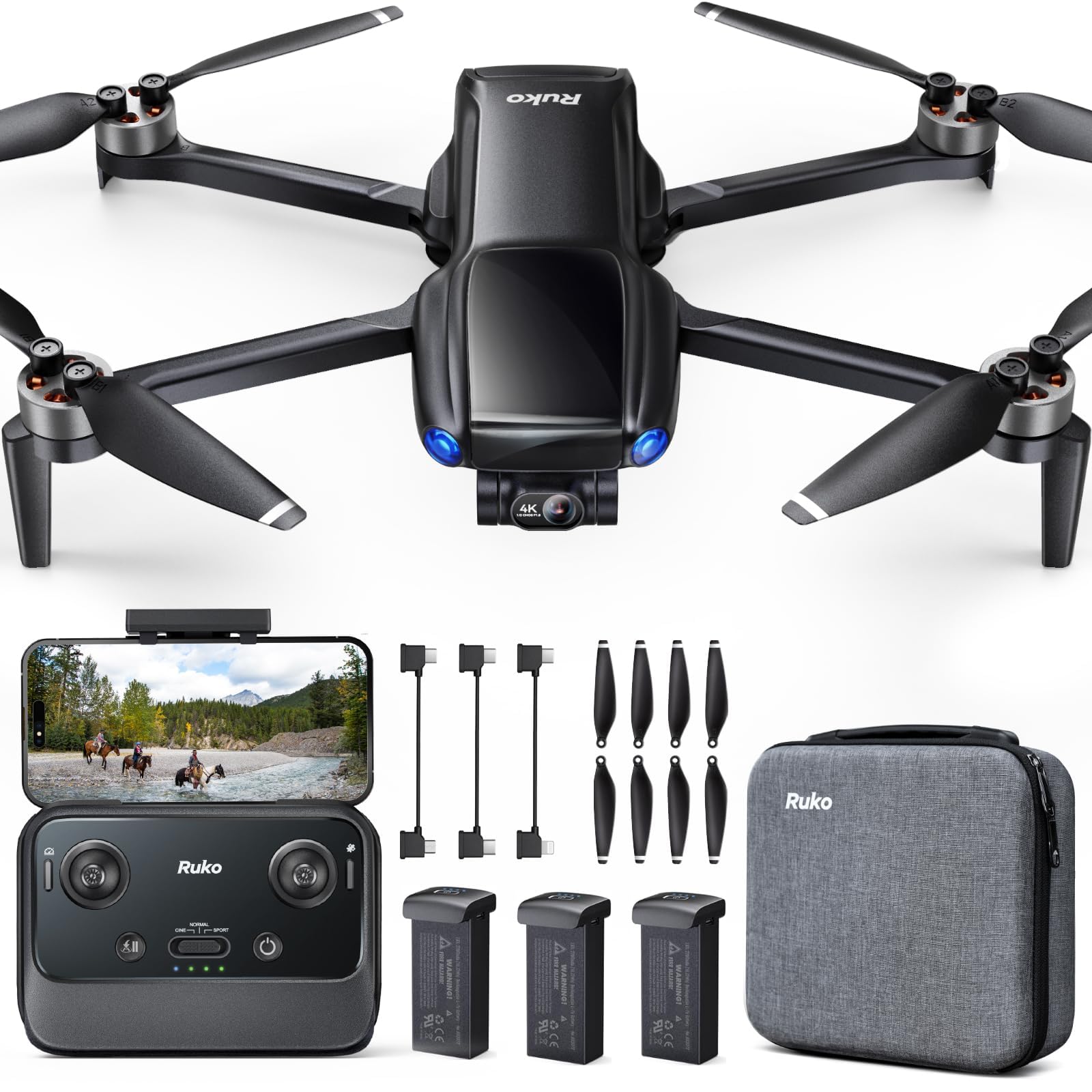
Three smart batteries, a carrying case, and quadruple positioning make the Ruko U11MINI the easiest family drone to take on a trip without buying extras. A 3-axis gimbal keeps 4K footage smooth, and the 248g weight keeps it travel-friendly. The top pick has more polished return-home and app behavior, but this kit is aimed at first flights.

This suits first-time owners and families who want enough batteries for a full outing and responsive support when something is unclear. The tradeoff: battery and charging QC can vary between units, and occasional flight-control glitches have been noted. Advanced users who need 10km transmission or RAW/LOG color should look at the feature-dense alternative.

💡 Start in beginner mode until the drone's control feel is familiar.

Pros

  • Beginner-focused flight modes make the first sessions manageable.
  • Three smart batteries and a carrying case cover a full family outing without extras.
  • Three-axis gimbal keeps footage smooth in moderate wind.

Cons

  • Battery and charging QC can vary between units.
  • Occasional flight-control glitches have been noted.
Our verdict

Families who want a full kit on day one, not a pro tool, get exactly that here.

Check Latest Price

How to Choose

Weight and Registration

Weight decides how easily a drone moves through a trip. Sub-249g models avoid recreational FAA registration and fit in a daypack. The trade-off: a lighter airframe has less momentum, so wind gusts push it harder and the gimbal must compensate.

Stabilization Type

A 3-axis mechanical gimbal keeps the sensor level with motors; EIS crops the frame and stabilizes in software. EIS hides small bumps but runs out of correction in wind or quick turns. For steady travel footage, choose a gimbal.

Flight Time and Batteries

Advertised flight time assumes no wind, a fresh battery, and a steady hover. Real travel adds wind, cold, GPS hover, and 4K recording, all of which drain the pack faster. A one-battery drone becomes a 10-minute shooting session by the time you frame the shot.

Count batteries before minutes. A three-battery kit means more total airtime and less charging downtime, which matters more on the road than any spec sheet.

Video Quality

4K is standard, so HDR, frame rate, and vertical capture separate travel drones. HDR preserves highlight detail in harsh sun; 60fps enables smoother slow-motion. Some models shoot true vertical for social, while others just crop a horizontal file.

Range and App Reliability

Range specs assume clear line of sight over open ground. In cities or near interference, usable range drops quickly. A screen controller removes the phone from the link and is usually more predictable than a tethered setup.

App availability matters before a trip. If the app is not available for your phone's operating system or requires a side-load, that becomes a pre-trip task. Confirm the connection works at home before you depend on it in the field.

Frequently Asked Questions