9 Best Camera Strap for Heavy Lenses of 2026: Ones That Stay Put

Find a camera strap for heavy lenses that stays on your shoulder and holds the connector secure — matched to telephoto, event, and travel work.

A strap advertised as 'heavy duty' only means something once it is carrying a 200-600mm zoom through a long day. The real test is how it behaves on your body: whether it stays on your shoulder, whether the connector holds, and whether the weight stays off your neck.

For heavy lenses, the first real fork is attachment. Tripod-socket slings carry the weight through the lens mount and keep big glass hanging naturally at your side; lug-mounted neck straps put more strain on both you and the camera eyelets. The second fork is shoulder behavior, because a wide pad that slides off is worse than a narrower pad that stays put.

A dedicated sling trades quick release and everyday polish for locked-in stability, a fair deal if your kit is a telephoto zoom. Match the strap to how you shoot, and you can avoid the two common complaints: a strap that creeps off your shoulder and a connector that works loose.

1

Best Overall for Heavy Lenses

BlackRapid RS-4 Sling

92 /100
Studio Score High Confidence

Key details

Pad & Grip
Straight foam pad, honeycomb overlay
Attachment Point
Tripod socket
Quick-Release Security
CR3 swivel + FR5 connector
Check Price on Amazon

The RS-4 carries heavy telephoto zooms on a one-point sling without putting the weight on your neck. The straight foam pad and honeycomb nylon overlay keep the strap planted on the shoulder, while front and rear spring cam locks adjust length on the fly. The CR3 swivel and FR5 connector hold a big lens in line with your body rather than letting it swing away, and the small zip pocket on the pad gives a spare card or key a convenient home.

Rigs in the 200-600mm class and approaching 20-lb stay put because the camera hangs from the tripod socket instead of the camera lugs. That single-point connection changes the load path: a long telephoto settles against the hip, so the shoulder and torso carry the weight while the neck gets none. The front and rear cam locks work without removing the strap, allowing independent tuning of the balance point, not just overall length. That is the difference between a strap that drifts in front of you and one that stays where you set it.

The RS-4 can be set up for right- or left-shoulder carry, and the CR3 swivel orients the camera to sit flat against your side. This is a dedicated sling, not an around-the-neck strap and not a multi-carry harness. Photographers who need one strap to switch between neck, shoulder, and sling modes will find a multi-mode strap more accommodating; the focus on a single carry style is also why the pad stays thin and the adjusters stay simple.

Wildlife, sports, and event photographers with heavy telephoto lenses are the primary fit. It is not for users who want a traditional neck strap or anyone unwilling to periodically inspect the connector and carabiner; the bottom screw takes the full camera load, so a quick check before longer shoots is part of ownership. If the one-point carry matches the way you work, the RS-4 does what a lug-mounted neck strap cannot: it keeps a 200-600mm lens off your neck without shifting under load.

The premium-priced build matches the gear it carries; the nylon overlay, metal swivel, and spring cam locks are the parts that justify the cost. For photographers with a clear sling preference, the RS-4 is a long-term piece of kit rather than a budget stopgap.

💡 A quick look at the carabiner and bottom screw before a long shoot takes seconds and keeps the one-point system sound.

Pros

  • High-quality construction with a durable feel through heavy use.
  • Comfortable with large telephoto zooms on long shooting days.
  • Secure camera hold with quick length adjustment without removing the strap.
  • Distributes weight away from the neck across the shoulder and torso.

Cons

  • Carabiner and bottom screw can show wear under heavy use; periodic inspection is part of ownership.
Our verdict

The RS-4 is the heavy-telephoto sling to start from: shoulder-planted, cam-adjustable, and off the neck in a way a lug-mounted strap can't match. The premium-priced build fits shooters who spend long days carrying a big zoom.
Check Latest Price
2

Most Versatile Premium Strap

Peak Design Slide Lite

96 /100
Studio Score High Confidence

Key details

Pad & Grip
Low-profile seatbelt webbing
Attachment Point
Camera lugs
Quick-Release Security
Anchor links + o-rings
Check Price on Amazon

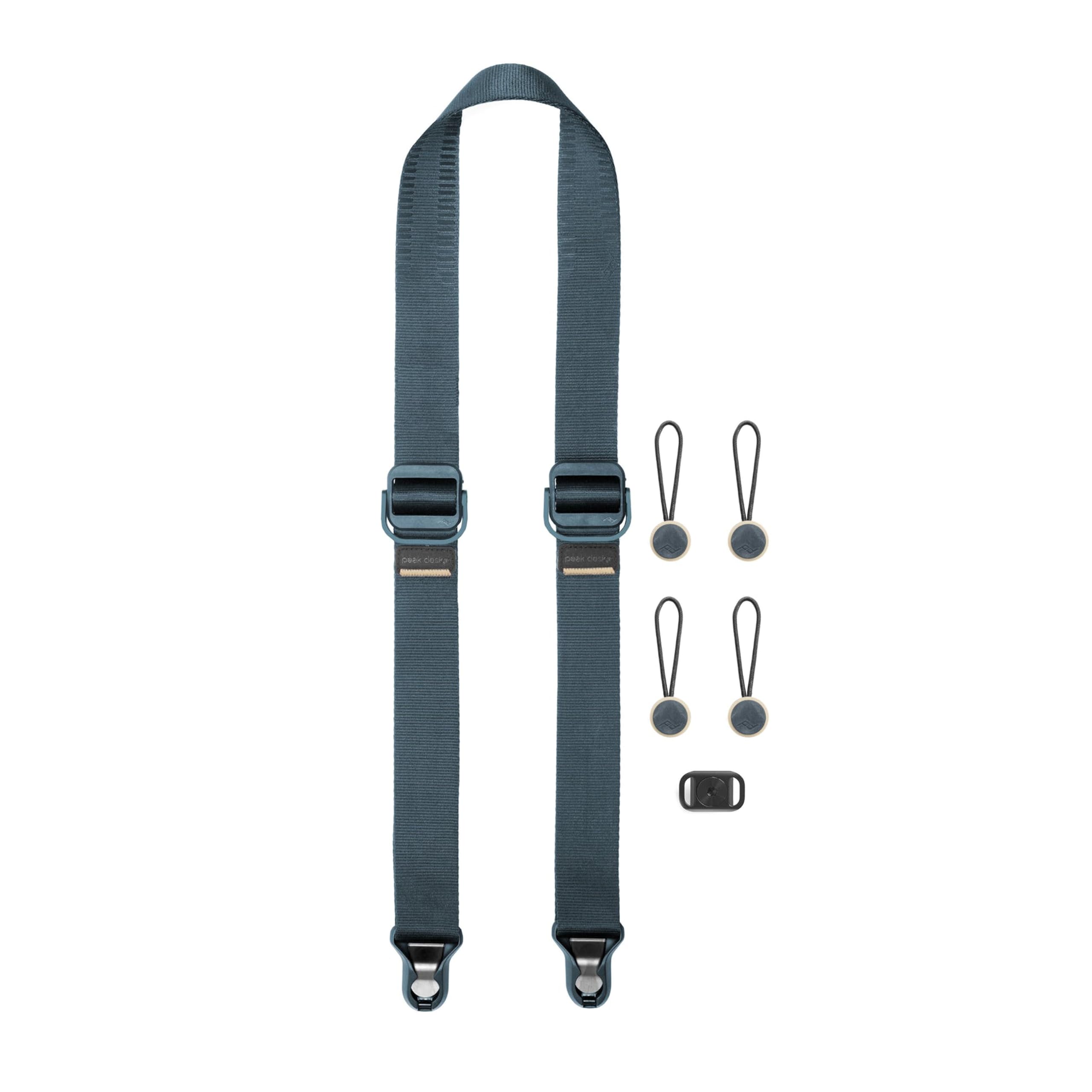
The Slide Lite packs neck, shoulder, and sling carry into a single strap. The Anchor quick-release separates the camera from the strap in one press, and dual sliding adjusters let you lengthen or shorten without removing the camera. That places it ahead of the top pick's one-point sling when the carry style changes several times in a day — over the neck for an event, across the body for a walk, on one shoulder for a crowd.

Full-size professional bodies sit comfortably on the seatbelt-style webbing, and the adjusters hold position while the strap is under load. The pad stays put on the collarbone and does not slip off a jacket shoulder as you move from street to venue. Finish quality is high, with no rough edges on the webbing or harsh transitions at the adjusters.

This is for hybrid, travel, and event shooters who want one strap that works on both a compact mirrorless body and a gripped DSLR. The Anchor links and supplied metal o-rings can be fiddly with small eyelets; swapping the o-rings solves that.

The Anchor hardware is shared with the broader Peak Design accessory ecosystem, so the strap can pair with the same connection hardware used by other Peak Design products.

Pros

  • Anchor quick-release detaches the camera from the strap in one press, so body changes are fast.
  • Dual sliding adjusters allow length changes without taking the camera off.
  • Pad and webbing carry full-size professional bodies without digging in.
  • Finish quality holds up under regular travel and event use.

Cons

  • Premium pricing sits above basic padded straps, so casual shooters may not use the quick-release advantage.
  • The lighter pad does not have the width of a maximum-width telephoto sling for sustained heavy-lens carry.
Our verdict

For photographers who switch carry styles several times in a shoot, the Slide Lite is the one strap to have on the camera.

Check Latest Price
3

Best Heavy-Duty Value

PGYTECH 1.8 Wide Strap

92 /100
Studio Score High Confidence

Key details

Pad & Grip
1.8-inch EPDM pad
Attachment Point
Tripod socket
Quick-Release Security
Dead-center locking connector
Check Price on Amazon

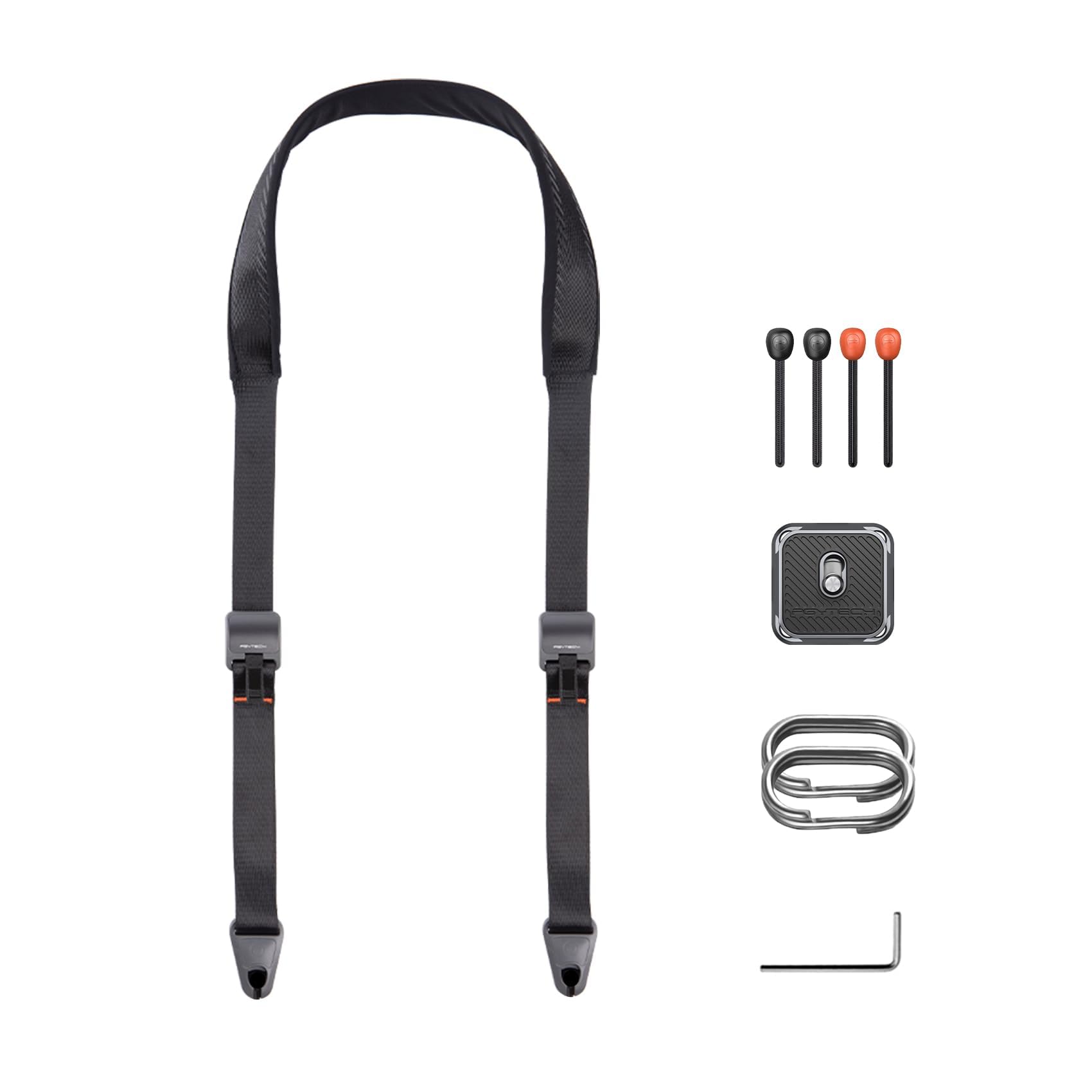
The PGYTECH 1.8-inch Wide Strap pairs a 90kg-rated cord and an Arca-style quick-release plate with a wide EPDM pad. The dead-center lock holds a gripped body and 70-200mm zoom level, and the plate drops straight onto a tripod clamp without unbuckling. It is the value-focused alternative to the underarm stabilizer in this lineup, trading active anti-swing for simpler tripod-first carry.

All-day comfort is the strongest point: the flat pad spreads load without digging, and dual quick adjusters make length changes easy while the strap is loaded. The three-layer webbing includes a replaceable wear-indicator lanyard, so you can catch cord wear before it becomes a problem. That combination explains why this mid-range strap feels engineered rather than generic.

Travel and studio photographers moving between shoulder carry and tripod work are the primary fit for this strap. The minimum loop length runs long, so shorter shooters who need a high, compact carry should check the fit first. Some third-party Arca clamps with tight tolerances may not seat the included plate; if your clamp is standard spec, the transition is quick and secure.

💡 Check the wear-indicator lanyard before long shoots and replace it when frayed.

Pros

  • Carries heavy DSLR kits all day without pressure-point digging.
  • Attach and detach are quick, and length adjusts smoothly under load.
  • Stays flat and stable on the shoulder instead of twisting.
  • Strong value for the engineering and load rating at this price.

Cons

  • Some third-party Arca clamps may not seat the included plate.
  • Minimum length can be too long for shorter users who want a high carry.
Our verdict

For tripod-first shooters who want serious load capacity without paying for underarm stabilization, this is the strongest value in the set.

Check Latest Price
4

Best Comfort-First Budget Pick

OP/TECH Pro Loop Strap

91 /100
Studio Score High Confidence

Key details

Pad & Grip
2.5-inch curved neoprene pad
Attachment Point
Camera lugs
Quick-Release Security
Pro Loop quick-release
Check Price on Amazon

Curved 2.5-inch neoprene pad and Pro Loop quick-release connectors spread weight across all-day shoots with DSLRs and 70-200mm or 100-400mm zooms. The non-slip backing holds the strap in place, and the quick-release connectors let you detach the camera without unthreading it. With heavy telephoto kits, the pad stays where you put it and avoids the shoulder creep that pulls a plain strap out of position.

All-day DSLR shooters with telephoto zooms are the core audience. Tall photographers who prefer crossbody carry may find the 40-46-inch length too short, and the curved neck pad may not match every neck shape. For shooters who keep the camera on a shoulder or around the neck, this strap is a cost-effective way to get durable, made-in-USA build quality.

The Pro Loop is a comfort-first neck/shoulder strap at a mid-range price. The quick-release connectors work well with standard eyelets, and the lifetime warranty backs the construction.

Pros

  • Curved 2.5-inch neoprene pad keeps heavy DSLR and telephoto combos comfortable through long shoots.
  • Weight spreads evenly and the non-slip backing keeps the strap planted on your shoulder.
  • Construction holds up to regular all-day use.
  • Made-in-USA build with a lifetime warranty delivers strong value at a mid-range price.

Cons

  • No tripod-socket quick-release; the camera attaches through its strap lugs only.
  • One-point sling carry isn't offered; this is a neck/shoulder strap.
Our verdict

The Pro Loop is a comfortable, durable neck/shoulder strap at a mid-range price, built for all-day DSLR work.

Check Latest Price
5

Best for Active Shooters

PGYTECH Strap Pro

84 /100
Studio Score Strong Evidence

Key details

Pad & Grip
60mm leather/EPDM pad
Attachment Point
Camera lugs
Quick-Release Security
Spherical quick-mount beads
Check Price on Amazon

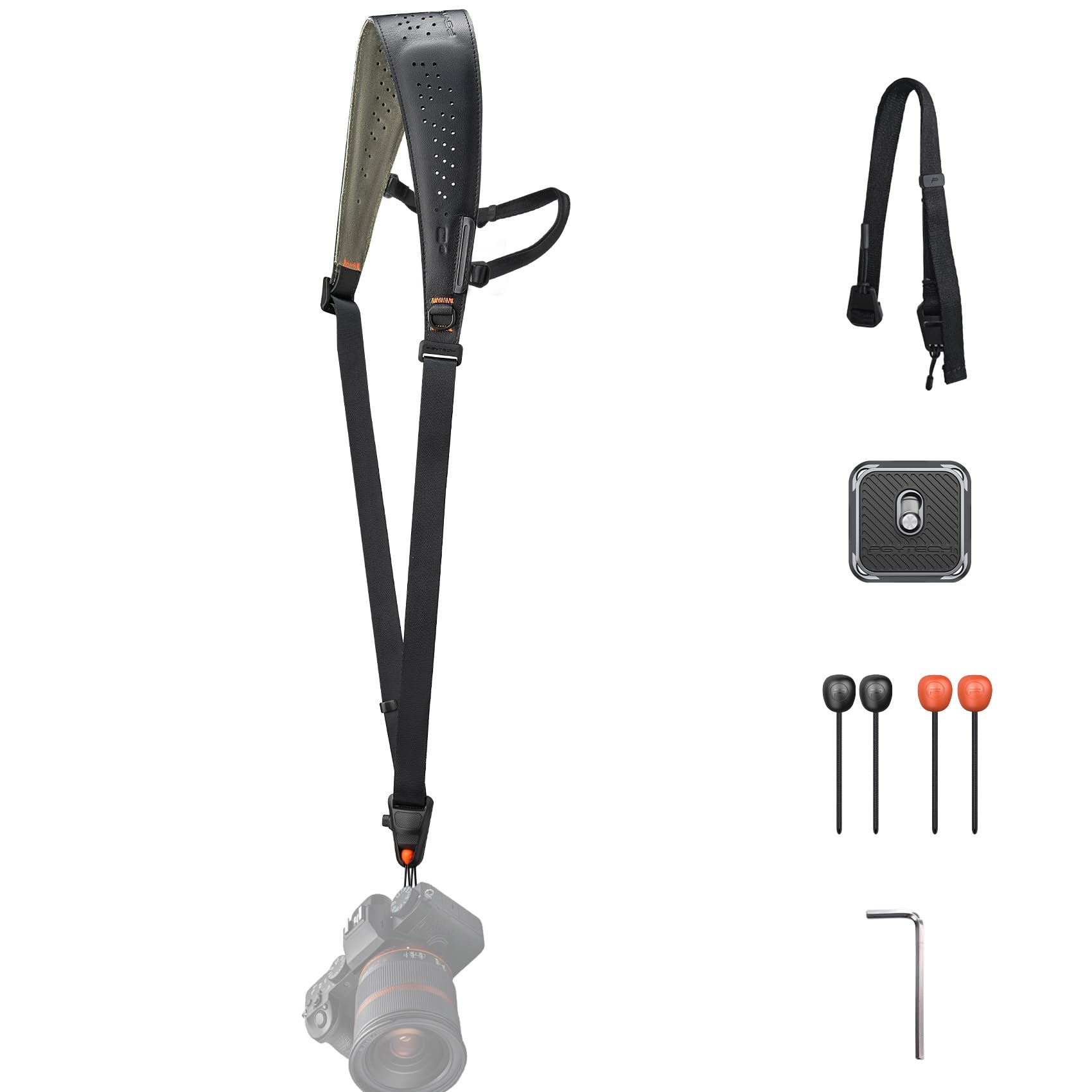
The four-position underarm strap is the defining feature: it holds the camera against you during quick turns instead of letting it swing into your side. That matters most with long telephoto zooms, where a one-point sling can whip around when you bend or pivot. Paired with 90kg-rated UHMWPE cords, the setup suits wedding, event, and sports work where you need the gear to stay put while you move.

The 60mm leather/EPDM pad spreads a heavier camera-and-telephoto combo across the shoulder without digging in, and the 56 vent holes help on warm outdoor shoots. Strap length spans 32.6 to 57 inches, which covers crossbody and shoulder carry for taller shooters. When detached from the camera, the strap packs small enough to tuck into a bag.

This is for active shooters who prioritize no-swing stability over a minimal profile, and who are okay with a learning curve: the quick-connect needs a deliberate seating motion before it locks, so it can feel awkward for the first few uses. Casual users with light kits are better served by a simpler padded neck strap, and buyers who don't need underarm stability can spend less.

Pros

  • Detachable underarm strap keeps the camera from swinging during quick turns.
  • Comfortable even with heavier camera and lens combinations.
  • Construction holds up through regular event use.
  • Compact and easy to pack when detached from the camera.

Cons

  • On smooth jacket fabrics, the shoulder pad can slide unless the underarm strap is engaged.
  • A rushed quick-release may not seat fully; the spherical bead needs a deliberate click before you trust it.
Our verdict

This is the strap to choose when you need a long-lens rig to stay put while you move, and the anti-swing behavior is worth the premium for working event and sports shooters.

Check Latest Price
6

Best Budget All-Day Strap with Storage

USA Gear TrueSHOT Strap

95 /100
Studio Score High Confidence

Key details

Pad & Grip
Stretch neoprene, non-slip backing
Attachment Point
Camera lugs
Quick-Release Security
Dual buckles + reinforced loops
Check Price on Amazon

The TrueSHOT carries a moderate DSLR or mirrorless kit on a stretch neoprene pad with non-slip backing and dual quick-release buckles. Memory-card pockets and side pouches keep small gear close, while reinforced 3/8-inch loops and a 3-year warranty round out the package.

Best for hikers, travelers, and hobbyists who want storage and all-day comfort with medium telephoto zooms. The strap length and quick-release seating are the two setup details to check before relying on it. If you shoot with a huge telephoto and need a tripod-mount sling, this strap sits outside that job.

The non-slip pad stays put on layered clothing, and the side pouches are an advantage over the softer no-pocket strap in this lineup. For moderate telephoto kits, the stretch neoprene absorbs enough road shock to remain comfortable across a full day of walking.

Pros

  • Comfortable stretch neoprene pad spreads weight well on long carry days.
  • Memory-card pockets and side pouches keep small gear accessible without a bag.
  • Cost-effective strap with sturdy construction and reinforced loops.

Cons

  • Strap length runs long for shorter torsos; trimming may be needed.
  • Quick-release clips can release the camera if they are not fully clicked into place.
Our verdict

The TrueSHOT covers the moderate-kit niche with genuine padding and pocket utility at a budget price. Huge-telephoto shooters should use a dedicated one-point sling instead.

Check Latest Price
7

Light-To-Mid DSLR

JJC Neoprene Neck Strap

92 /100
Studio Score High Confidence

Key details

Pad & Grip
2.36-inch neoprene pad
Attachment Point
Camera lugs
Quick-Release Security
Hook-and-eyelet clips
Check Price on Amazon

Dedicated neck-strap wearers get a soft 2.36-inch neoprene pad with enough give for moderate DSLR kits, and the low price makes it a sensible first upgrade from a stock strap. The included wrist-strap conversion adds utility without extra cost. This is not a heavy-telephoto sling: length and eyelet-only attachment keep it out of that class of load, so a purpose-built one-point sling is the better match for 150-600mm lenses. For casual neck carry and binocular use, it remains a comfortable budget buy.

Pros

  • Soft 2.36-inch neoprene pad keeps light and mid-size DSLR kits comfortable during longer carries.
  • At an entry-level price, the build quality undercuts most padded straps without feeling cheap.
  • Carries moderate SLR loads without digging in and converts to a wrist strap.

Cons

  • Eyelet-only connectors can be fiddly to feed through small strap eyelets.
  • Taller users may find the length short for crossbody sling carry.
Our verdict

Fits as an everyday neck carry for modest kits; heavy-telephoto shooters will want a dedicated sling.

Check Latest Price
8

Light Mirrorless Kits

K&F Concept Neck Strap

88 /100
Studio Score Strong Evidence

Key details

Pad & Grip
58mm neoprene, anti-slip backing
Attachment Point
Camera lugs
Quick-Release Security
UTX safety buckle
Check Price on Amazon

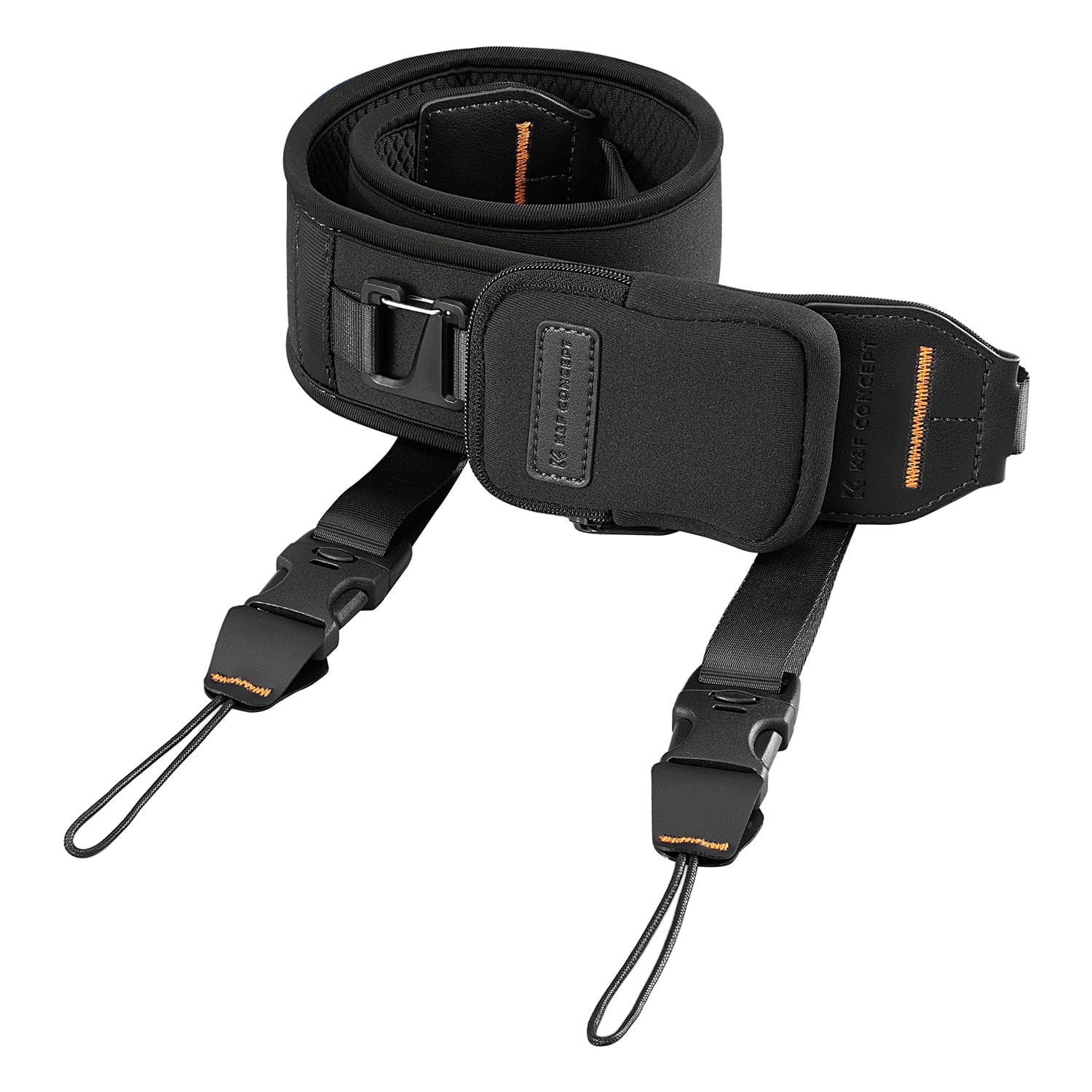
The K&F Concept Camera Neck Strap pairs a wide 58mm neoprene pad with a removable zipper pocket, giving a light mirrorless kit comfortable all-day carry and a tidy spot for a spare battery or SD card. The quick-release clips attach without fuss, and the three-layer braided rope adds security at a budget-friendly price. What keeps it out of the top tiers is fit consistency: the minimum length can still hang low on petite frames, while taller users may run out of adjustment. That makes it a sensible neck-strap option for moderate camera bodies, not a universal fit for every torso.

Pros

  • Good build quality with UTX safety buckle and three-layer braided rope.
  • Attaches and adjusts easily, so switching between camera bodies is quick.
  • Removable zipper pocket fits a spare battery or SD card.

Cons

  • For sling-style carry, no tripod-socket plate is available, so connection stays on the camera lugs.
  • Under a long telephoto zoom, the neck pad carries weight that a one-point sling would put on the shoulder.
Our verdict

Use this when your kit stays light-to-moderate and you want an inexpensive padded strap with a pocket.

Check Latest Price
9

Hikers and Street

Altura Photo Camera Strap

89 /100
Studio Score Strong Evidence

Key details

Pad & Grip
Padded sling pad
Attachment Point
Tripod socket
Quick-Release Security
Tripod-screw quick release
Check Price on Amazon

Altura's budget sling gets a moderate DSLR or mirrorless kit off your neck through the tripod-socket quick release and adds a useful safety tether, which fits street shooting or easy trail walking. The padded shoulder section and small pocket keep the carry light, and the build quality holds up well for the price. Refinement is a step below the top slings, so treat this as an entry-level quick-access strap for light-to-mid kits rather than a heavy-telephoto workhorse. The value is real for hikers who want a low-cost way to stop swinging a camera across their chest.

Pros

  • Solid build quality for the price, with no flimsy feel when you pick it up.
  • Light, portable sling-style carry that keeps the camera accessible on hikes and street walks.
  • Cost-effective sling option that delivers more than the price suggests.

Cons

  • On uneven trails, the pad can shift out of place; a quick reset fixes it.
  • The quick-release clip and tripod screw can wear under heavier use; both deserve regular checks.
Our verdict

This is the budget entry point for quick-access sling carry, and it stays within that lane.

Check Latest Price

How to Choose

Attachment Point

Attachment point determines which part of the camera carries the load. A tripod-socket strap routes weight through the lens mount and body, which suits heavy telephoto rigs and keeps the camera hanging lens-down or at your side. Lug-mounted straps pull on the camera's strap eyelets, which are often small metal loops rated for a body, not a body with a long telephoto zoom hanging off the front.

Load Rating and Webbing

Load ratings are rare, and when a strap lists one, it usually refers to the cord or webbing, not the connector. A 90kg rating on a UHMWPE cord means the strap material itself can hold far more than any camera you will hang from it; the weak point is the screw, clip, or buckle at the end. That is why a safety tether matters more than an impressive loop rating.

Pad Width and Grip

Pad width is less important than pad shape and backing. A wide pad distributes weight, but if it slides off a sloped shoulder, you will be adjusting it every few minutes. EPDM, silicone, or textured neoprene backing creates friction against clothing; curved or contoured pads also wrap the shoulder better than flat foam.

Length Range

Length range controls how the camera sits and whether the strap works for your height and carry style. Neck straps need to reach your chest without choking; slings need to tuck under the opposite arm for crossbody access. A strap that cannot shorten enough for a petite shooter or lengthen enough for a tall one will never feel right regardless of padding.

Quick-Release Security

Quick-release hardware is a convenience until it becomes a connection point. Magnetic or snap releases are fast, but they depend on full seating; a partially clipped connector can release when you swing the camera around. Redundant safety tethers exist because connectors are the parts that wear, loosen, or get bumped.

Frequently Asked Questions