6 Best Camera Sling Bags of 2026: Find Your Capacity Class

Camera sling bags look similar, but internal size and strap comfort vary. Match capacity and access to your mirrorless or DSLR kit before buying.

Camera sling bags look similar in listings, but they actually divide into three capacity classes: miniature cases for point-and-shoots, 5-6L everyday slings, and 9-11L multi-compartment bags. Gear that fits one class can be too tight to close in another. The first step is measuring your largest body with the biggest lens you shoot mounted.

Once the size fits, the strap is the next boundary. A loaded sling concentrates weight on one shoulder, so adjustability and padding decide whether an all-day walk feels fine or tires you out. Buyers often choose the bag with more pockets, then discover the strap was the actual purchase factor.

The practical tradeoff is roomier multi-lens capacity versus a compact sling that stays light and easy to swing forward. Decide which class matches how you actually carry a camera before comparing features.

1

Best Overall

K&F Everyday Sling

92 /100
Studio Score High Confidence

Key details

Access Design
โ€”
Extra Utility
Tripod straps
Strap And Fit
Non-removable, 34-55 in
Capacity And Size
10L; 10.6x6.7x4.1 in
Check Price on Amazon

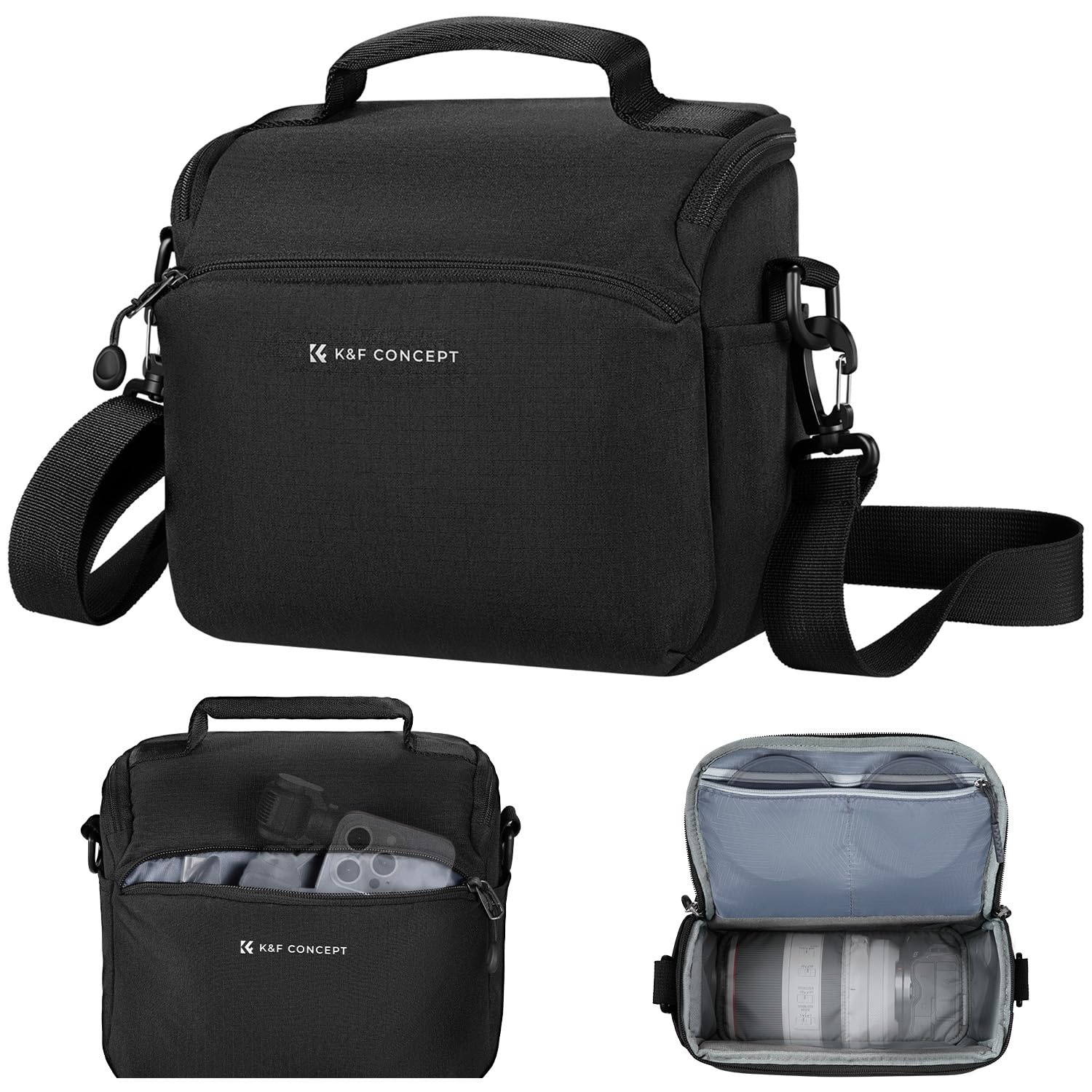
The 10L layout is the main draw: adjustable dividers create room for a mirrorless body or mid-size DSLR plus one or two lenses, and the main compartment measures roughly 10.6 by 6.7 by 4.1 inches. The divider system can be set for a body with lens attached or a body plus a detached lens stacked flat. The exterior stays close to the body at 13 by 8.6 by 5.9 inches, so it doesn't swing wide in crowded spaces. Underside straps cinch a compact tripod to the bottom, which keeps the camera space clear. At 1.32 lb, the padding and layered construction add meaningful protection without turning the bag into a burden on a long walk or travel day.

Crossbody, sling, shoulder, messenger, and hand-carry modes come from the same strap and top handle, so the bag adapts to how much you want it bumping around. Side pockets open without pulling the main flap, which matters when you need a filter or phone mid-shoot. A front organizer holds chargers, cards, and small personal items, while the main divider keeps the camera section from mixing with the rest of your gear. You can also swing the bag around and reach the side opening for a quick lens swap without setting it down. Zippers run smoothly, and the fabric handles the normal scrapes of transit and sidewalks without showing wear.

Reinforced stitching is concentrated at the strap anchor and bottom corners, the spots that get stressed on any single-strap bag under load. The bag holds its shape with a camera and two lenses inside, and the dividers do not shift after repeated rearranging. For the price, the feature set is fuller than typical dedicated camera slings at this level, which makes it a practical pick for a first camera bag or a travel-only bag.

This is for everyday and travel photographers who shoot a mirrorless body or mid-size DSLR and want one bag for gear, personal items, and a compact tripod. The fixed, non-detachable strap is the main boundary: height range spans about 34 to 55 inches, but taller or larger users should test the fit with the bag loaded before buying. Gripped full-frame bodies with long telephotos and ultra-compact minimalist kits are better served by other bags in the lineup - the lighter 5L sibling takes the minimal side, while a larger dedicated camera pack is the right call for heavy telephoto rigs.

๐Ÿ’ก Bottom straps are sized for compact tripods; a full-size tripod is a separate-carry item.

Pros

  • Sturdy, well-padded construction protects a mirrorless or mid-size DSLR and lenses during daily carry.
  • Adjustable 10L interior fits a camera body plus one or two lenses, with pockets for personal items.
  • Crossbody, shoulder, messenger, or handbag carry modes suit changing day plans.
  • Strong value at its price point; the feature set is more complete than the modest cost suggests.
  • Reinforced sections and thick layers hold up under repeated travel and everyday use.

Cons

  • Large DSLR bodies or long zooms make the 10L interior feel tight and can reduce usable pocket space.
  • The shoulder strap cannot be detached or swapped, so users outside its range have no alternative carry option.
Our verdict

For mirrorless and mid-size DSLR shooters who want one bag for camera gear, a compact tripod, and personal items, this is the balanced pick in the lineup.
Check Latest Price
2

Best Compact Value

K&F Small Crossbody

93 /100
Studio Score High Confidence

Key details

Access Design
Wide top opening
Extra Utility
โ€”
Strap And Fit
Adjustable, 29.5-52.7 in
Capacity And Size
5L; 8.3x6.8x4.3 in
Check Price on Amazon

The K&F Concept 5L small crossbody is the compact alternative to the 10L Everyday Sling: it weighs 0.61 lb and its wide-opening main compartment keeps a mirrorless body with a compact lens accessible while the bag holds the footprint of a small crossbody case. That makes it a light everyday carry rather than a multi-lens kit bag.

The main compartment measures 8.3 x 6.8 x 4.3 in, so a camera body plus one spare lens fits without the load feeling cramped. Front and internal pockets sort extra batteries, memory cards, and small accessories, and the 29.5โ€“52.7 in strap range allows it to ride snugly across different body heights. At this weight, the sling is easy to forget until you need the camera.

This is for mirrorless and small DSLR owners who want an everyday sling for a body and one or two compact lenses instead of a bag to haul a full kit. The 5L compartment is boundary-limited: large telephoto lenses and gripped full-frame bodies will not fit, so shooters with that gear should step up to the 10L counterpart. For the small-kit buyer, the tradeoff buys a genuinely light bag with proper padding and quick access.

๐Ÿ’ก Pack the body with one compact lens attached and keep spare items in the pockets; the compact interior rewards deliberate packing.

Pros

  • Build quality at this price and weight is hard to fault.
  • The 5L interior fits a body plus one or two compact lenses without feeling overstuffed.
  • Compact dimensions suit photographers who prefer a small-kit bag over a multi-compartment case.
  • Pockets organize spare batteries and memory cards without stealing room from the body and lens.

Cons

  • Once a gripped full-frame body or telephoto zoom is the main carry, the 5L interior hits its boundary.
Our verdict

Travelers with a mirrorless body and one or two compact lenses get a budget-friendly, low-bulk sling that protects the camera without demanding its own suitcase.

Check Latest Price
3

Best Discreet Travel Sling

BAGSMART Canvas Sling

92 /100
Studio Score High Confidence

Key details

Access Design
Flap-and-buckle closure
Extra Utility
Rain cover
Strap And Fit
Detachable padded strap
Capacity And Size
11L; 11x5x7.9 in
Check Price on Amazon

Vintage canvas shell, 11L capacity, and a concealed rain cover make this crossbody read as a normal day bag rather than camera gear. The smaller BAGSMART mini in the lineup owns compact lifestyle carry; this one adds enough interior for a mirrorless body plus a spare lens while keeping the outside understated.

The 10mm padding surrounds the main compartment and the padded strap spreads weight across one shoulder. A rain cover tucks into a hidden pocket, so a sudden downpour doesn't mean digging out an extra accessory. Nothing about the exterior advertises what is inside, which is the point.

Travelers and everyday shooters who want one-strap access and a low-key silhouette are the right audience. The flap-and-buckle closure can be fiddly to align and secure, so photographers who prefer zipper-only enclosures should treat that as the deciding factor.

At a mid-range price, you get weather protection, a padded interior, and a canvas exterior that fits a compact travel kit without the camera-brand look.

๐Ÿ’ก Close the flap with both hands and give the magnetic buckle a firm press; it seats cleanly when you don't rush it.

Pros

  • Build quality holds up across regular travel use.
  • Plain canvas exterior passes as a normal day bag, not camera gear.
  • 11L interior with 10mm padding fits a mirrorless body and accessories.
  • Concealed rain cover handles sudden weather without adding bulk.

Cons

  • A second camera body or a large telephoto lens does not fit the 11L layout.
  • Flap-and-buckle closure can be fiddly to secure; a rushed close leaves the bag less enclosed than a zipper.
Our verdict

Travelers with a compact mirrorless kit who want a low-key, weather-ready sling can stop measuring; this bag covers the essentials without the camera-brand look.

Check Latest Price
5

Best Organized Modular Sling

TARION TR-S Sling

90 /100
Studio Score High Confidence

Key details

Access Design
Side-access compartments
Extra Utility
Tripod side pocket
Strap And Fit
Fixed right-shoulder, 48.4 in
Capacity And Size
9L; 16x7x12 in
Check Price on Amazon

The TARION turns a 9L camera sling into a set of dedicated storage zones: padded main compartment, side-access opening, hardshell top pocket, and a tripod side slot. A mirrorless body plus two to three lenses stays sorted without digging through one large cavity, and interior pockets keep spare batteries, filters, and memory cards from sliding into the camera compartment.

The shell, zippers, and divider attachments feel solid for the price, and the bag holds its shape even when partially packed. At 1.85 lb, it is light enough for a day bag, while the hardshell top pocket protects sunglasses or small accessories. The side-opening panel lets you pull out the camera without taking the bag off, and the strap adjusts to 48.4 in for a range of torso lengths.

For right-shoulder mirrorless users, the separated 9L layout is a practical hiking and travel companion, with the tripod slot keeping the main compartment free for camera gear. Shooters who prefer left-side carry or have broad frames should consider the 10L alternative. Front and top pockets handle keys, a phone, and small accessories without crowding the camera compartment.

๐Ÿ’ก Keep the heaviest lens closest to your back and use the tripod slot to balance the load.

Pros

  • Padded dividers keep a mirrorless body and two to three lenses in separate, quick-access zones.
  • Housing and zippers hold up on regular trail and travel use.
  • Dedicated pockets keep filters, batteries, and small accessories from rattling around.
  • Travel-friendly layout carries well on day hikes and doubles as a city daybag.

Cons

  • Large full-frame telephoto setups exceed the 9L main compartment.
  • With heavier kits, the single strap can create shoulder fatigue during longer carries.
Our verdict

For organized 9L storage on day hikes and travel, this sling delivers a clear layout and solid build.

Check Latest Price
6

Budget Travel Utility

TAAOKA Waterproof Sling

89 /100
Studio Score Strong Evidence

Key details

Access Design
โ€”
Extra Utility
Luggage strap, tripod holder
Strap And Fit
Adjustable, 13.5-51.1 in
Capacity And Size
9L; 12.6x5.1x7.8 in
Check Price on Amazon

Waterproof fabric, a luggage strap, an external tripod holder, and a budget price make this one of the best-equipped slings for travel. The main compartment fits a mirrorless or small DSLR body plus two to three lenses, and the pocket layout keeps batteries, memory cards, and filters accessible without unpacking the camera.

It trails the top group in long-term durability consistency, so treat it as a travel bag for occasional trips rather than a daily workhorse. The waterproof shell and tripod holder are the standout inclusions at this price.

Pros

  • Main compartment fits a mirrorless or small DSLR body plus two to three lenses.
  • Pockets keep batteries, memory cards, and filters quick to reach without opening the main compartment.
  • Luggage strap, tripod holder, and waterproof fabric cover the extras travelers often add later.

Cons

  • Padding is thin for heavy telephoto lenses or camcorders; a mirrorless kit is the comfortable range.
  • Zipper and seam durability can vary after months of regular use; check the stitching before daily heavy loads.
Our verdict

Travelers and vloggers with a mirrorless kit and a compact tripod get the utility without the pro bag price.

Check Latest Price
7

Tiny Kits

BAGSMART Puffy Mini

88 /100
Studio Score Strong Evidence

Key details

Access Design
โ€”
Extra Utility
โ€”
Strap And Fit
Adjustable, 11-24 in
Capacity And Size
3.6L; 9.8x4.1x5.5 in
Check Price on Amazon

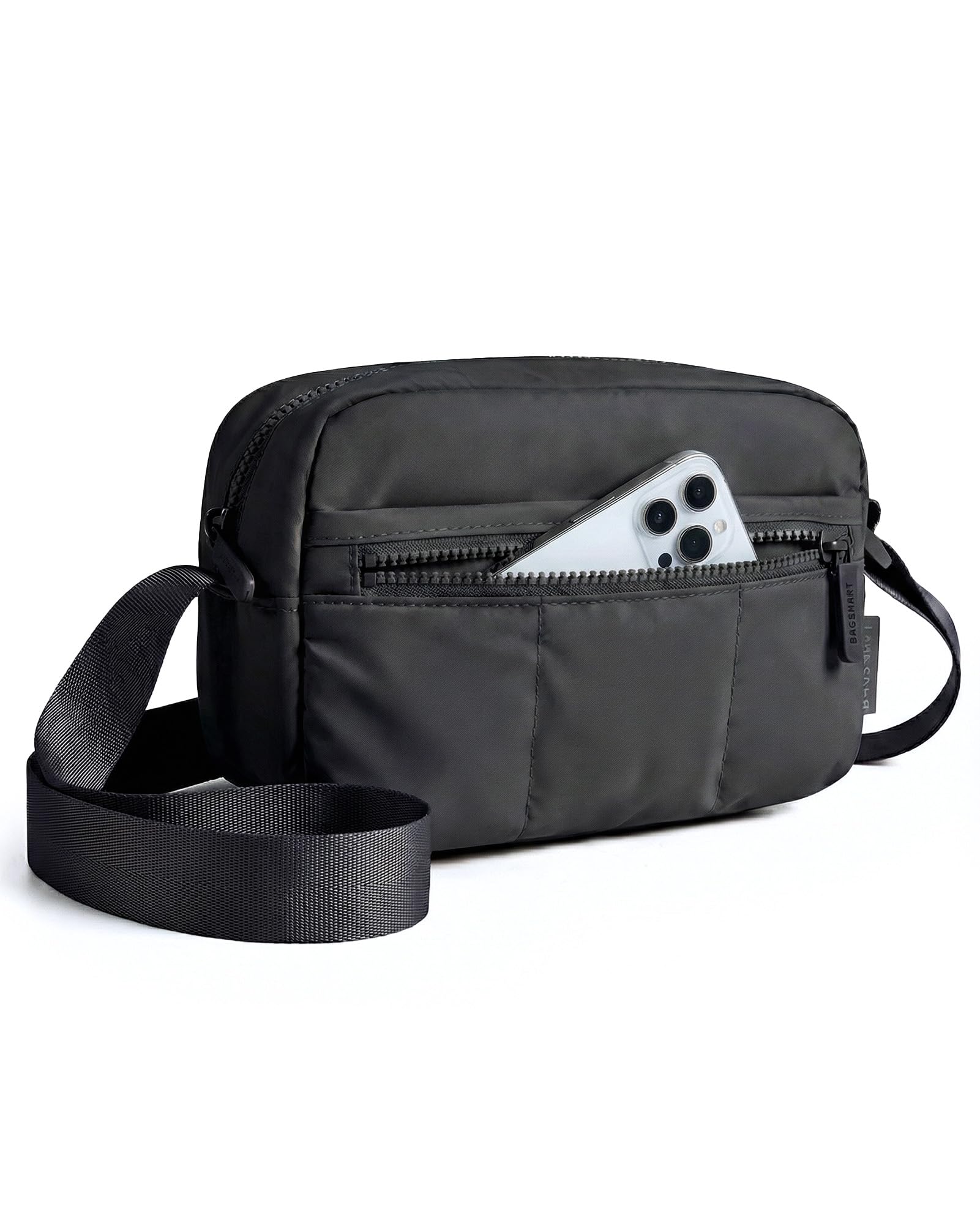
The 3.6L, 0.42 lb body reads as a fashion crossbody rather than camera gear, and it carries a point-and-shoot or compact mirrorless with minimal bulk. Build quality is stronger than the budget price implies, and the puffy shell makes the camera bag look like an everyday accessory. The tradeoff: the interior is tight enough that an interchangeable-lens camera may fit only with the lens detached in some configurations, and a gripped DSLR body is out of the question. That compactness also caps the gear list at a minimal kit, which is why this sits below the more flexible 10L slings in this set; for larger photo kits, the canvas travel sling is the better match.

Pros

  • At 0.42 lb and 3.6L, it disappears into a bag or carries alone as a tiny crossbody.
  • Stitching, zippers, and fabrics feel above the budget price point for such a small bag.
  • Puffy silhouette reads as a fashion accessory rather than a camera case.

Cons

  • At 3.6L, a lens-attached mirrorless body may not fit; be ready to detach the lens for some kits.
Our verdict

For point-and-shoot owners and compact mirrorless shooters, this is a grab-and-go crossbody that pulls double duty as a purse.

Check Latest Price

How to Choose

Capacity and Internal Size

Sling-bag capacity labels refer to total volume, not the usable camera compartment. A 10L bag can lose a third of that space to padding, dividers, and curved corners, which is why a gripped full-frame body or a long telephoto often won't fit even when the outer dimensions look generous.

Measure your body with its longest lens attached, including the lens hood reversed. Compare that against the bag's internal dimensions, not the brand's general 'fits DSLR' claim.

Access Design

Access design controls how fast you can get the camera out and how protected it stays while you move. Wide side-opening or clamshell designs let you swing the bag forward and grab the body without taking it off; top-loading designs can force you to unzip and reach around a divider.

Flap-and-buckle closures look clean but take both hands to align, and if the flap is not seated, the opening can sit partially exposed. For street or event shooting, favor a zippered opening that opens wide and closes in one pull.

Strap Fit and Adjustability

Single-strap bags put all weight on one shoulder, so strap design determines whether a loaded bag feels balanced or tiring after a few hours. A strap that is too short for your torso pulls the bag tight across the chest; a non-removable strap also rules out using the bag as a normal shoulder tote.

Look for a length range that matches your height, and check whether the strap is padded and detachable. If you carry a full kit, the strap should sit comfortably across the body without digging in.

Padding and Water Resistance

Padding protects the camera from hard knocks, but thick padding eats internal space. Light padding keeps a bag compact and light; it also transfers more impact to the body when the bag hits a door frame or rocks on a trail.

Water resistance comes from the shell fabric, zippers, or a separate rain cover. A rain cover adds weather security without adding permanent bulk; sealed zippers are better in steady rain but often cost more and stiffen the opening.

Tripod and Travel Extras

Tripod holders, luggage straps, and anti-theft back pockets make a sling more useful, but each extra adds weight and can reduce the clean profile. A luggage strap is valuable when the sling will ride on a rolling suitcase; a tripod holder is only useful if your tripod's folded length fits the strap.

Decide which extras match your routine before prioritizing them. A bag that covers one real need is easier to live with than one that carries a feature list you never use.

Frequently Asked Questions