7 Best Camera for Astrophotography of 2026: Match to Your Targets

Beginners comparing telescope cameras with full-frame bodies: the right astrophotography pick depends on target — Moon, planets, deep-sky, or Milky Way.

The word astrophotography covers two very different camera jobs. A low-cost eyepiece camera that puts the Moon on your laptop screen cannot reach the faint glow of a nebula, and a 24MP mirrorless body that captures the Milky Way will not slide into a telescope's 1.25-inch focuser. Most of the disappointment in this category comes from treating them as the same purchase.

The deciding spec is the target. Lunar and planetary imaging rewards high frame rates and small sensors; deep-sky and nightscape work demands long exposures and large sensors that gather light. In between sits the real trade-off: full-frame bodies deliver the cleanest night skies but cost more and weigh more than an APS-C camera that still handles most astro work well.

This guide sorts the options by what you plan to shoot — Moon and planets through a scope, guided imaging, or wide-field night landscapes — so you can match the camera to the target instead of the label.

1

Best Overall

Canon EOS R50

89 /100
Studio Score Strong Evidence

Key details

Max Exposure
30s, bulb
Software & OS
SD card, no driver
Mount Standard
Canon RF mount
Sensor & Low Light
24.2MP APS-C CMOS
Check Price on Amazon

The R50's 24.2MP APS-C sensor and DIGIC X processor produce crisp images in a body light enough to carry all day. It is an interchangeable-lens camera, not a telescope-attached astronomy camera, and that boundary works in its favor: one body covers daylight shooting, video, and wide-field night-sky frames. Dual Pixel CMOS AF II keeps focus responsive, while uncropped 4K30 from a 6K oversample and FHD 120p give timelapse flexibility that small-sensor astronomy cameras cannot match. Burst shooting reaches 12fps with the electronic first curtain and 15fps electronic, so daytime action does not demand a second body. It is not the cheapest entry-level mirrorless, but the combination of AF, video, and burst is uncommon at this weight.

Point it at the Milky Way with a fast prime and the R50 handles the job well. The right wide-angle prime makes the difference for astro landscapes. Full-frame bodies gather more light for faint deep-sky targets, and the Sony a7 III in this set is the stronger low-light instrument, but the R50's weight and mid-range price keep it the easier carry for mixed travel and night-sky duty. A star tracker extends its reach for deep-sky work, but that is an add-on rather than a built-in function.

First-time mirrorless owners get a gentler learning curve here: auto modes, touch AF, and the vari-angle LCD cover the basics before you switch to manual for a nightscape. The 2.36M-dot EVF is a usable finder for daytime framing, and the burst modes handle moving subjects without forcing you into a heavier camera. The touchscreen is responsive enough for quick focus pulls, and the flip-out hinge is a practical aid on a tripod.

The buyer this fits best is a travel or vlog shooter who also wants occasional astro landscape captures. Battery endurance is average, so a full night out calls for a spare. If telescope-attached planetary imaging is the main goal, keep a dedicated astronomy camera for that specific role.

The R50 is not a deep-sky instrument; that work demands a different workflow. Within its wide-field boundary, it is a practical single body for photographers who want daylight, video, and night-sky from one lightweight kit.

Pros

  • Modern 24.2MP sensor and DIGIC X deliver crisp photos in a portable body.
  • Strong hybrid set of features - 4K30, 120p FHD, fast AF - at a mid-range price.
  • Beginner-friendly auto modes and portable design ease the move from phone to dedicated camera.
  • 12fps mechanical and 15fps electronic burst cover daytime action without a second body.

Cons

  • The bundled 18-45mm zoom is a daylight lens; serious night-sky work needs a fast prime.
  • The compact body is too small for some users' hands.
Our verdict

For travel-minded shooters who want occasional astro landscapes without a full-frame kit, the R50 is the balanced fit: compact enough to carry daily, capable enough for wide-field night-sky frames.

Check Latest Price
2

Best Full-Frame for Night Sky

Sony a7 III

89 /100
Studio Score Strong Evidence

Key details

Max Exposure
30s, bulb
Software & OS
SD card, no driver
Mount Standard
Sony E-mount
Sensor & Low Light
24.2MP BSI full-frame
Check Price on Amazon

The a7 III is the full-frame night-sky powerhouse of this set, pairing a BSI 24.2MP sensor with high-ISO headroom that makes Milky Way framing a normal part of the workflow. Sensitivity spans 50 to 204800, and 5-axis IBIS steadies handheld night shots while 693-point phase-detect AF covers 93% of the frame. The top pick in this group is the easier daily choice, but it can't match this sensor when faint light is the main subject.

Eye tracking locks onto people, which keeps foreground subjects sharp when shooting wide at f/1.8 or f/2.8. The same body handles 4K video, 10fps bursts with AF/AE tracking, and dual card slots, so a night out can pivot to event work without a second camera. Color stays coherent at high ISO, which is what keeps a Milky Way-plus-foreground composition looking natural.

This is for astro landscape shooters who want full-frame light gathering and can accept a clunky menu, a bundled 28-70mm that is not a night-sky lens, and an incoming unit that can be non-functional or used. Those caveats are real; for an astro-first buyer, the sensor's low-light character is the payoff, and the deep lens catalog gives clear upgrade paths beyond the kit zoom.

Pros

  • Full-frame BSI sensor holds clean high-ISO output for Milky Way and night-sky frames.
  • 693-point AF with eye tracking keeps focus locked on foreground and people during long sessions.
  • 4K video, 10fps burst, 5-axis IBIS, and dual card slots cover event work alongside astro.

Cons

  • Layered menu means setting changes take time during an astro session when conditions shift.
  • Bundled 28-70mm lens is slow and soft on stars, so budget for a fast prime.
  • Units can arrive non-functional or clearly not new, so check the body before relying on it.
Our verdict

Astro landscape shooters who also need event-duty autofocus and 4K get the full-frame low-light ceiling they came for; the top pick stays the lighter everyday body.

Check Latest Price
3

Best Budget Beginner DSLR

Canon Rebel T7

94 /100
Studio Score High Confidence

Key details

Max Exposure
30s, bulb
Software & OS
SD card, no driver
Mount Standard
Canon EF/EF-S
Sensor & Low Light
24.1MP APS-C CMOS
Check Price on Amazon

The Rebel T7 kit is the classic DSLR learning path: a two-lens kit and an in-camera guide mode that walks new shooters through aperture, shutter speed, and ISO. Its optical viewfinder and 24MP APS-C sensor keep the experience closer to traditional photography than the mirrorless alternative in this set.

This is the right body for a budget-focused beginner who wants a general-purpose DSLR for family, travel, and daylight scenes, and it can handle Moon snapshots or basic Milky Way shots when paired with a fast prime and a tripod. The dated 9-point AF and ISO ceiling near 6400 show their age in dim scenes, and a new unit can arrive unable to power on; neither is a dealbreaker for daytime family photography, but both are worth checking.

Live-view autofocus is slow, so the optical viewfinder is the better tool for moving subjects; in low light the system can hunt before locking. The built-in guide mode partially offsets the learning curve by explaining settings in plain language instead of forcing a manual dive.

The two-lens kit stretches from 18mm wide-angle to 300mm telephoto, covering group shots, portraits, and distant subjects without an immediate second purchase. At a budget-friendly price, that scope makes the T7 a complete first system rather than a body that needs more glass right away.

💡 Use the optical viewfinder autofocus for moving subjects and save live view for static shots — it is noticeably slower.

Pros

  • Two-lens kit covers wide-angle to telephoto, so beginners get a full range without buying more glass.
  • In-camera guide mode explains aperture, shutter speed, and ISO as you shoot.
  • 24MP APS-C sensor delivers image quality that holds up for prints and casual astro.

Cons

  • Live-view autofocus can hunt in dim conditions; optical viewfinder phase-detect is more dependable.
  • A unit can arrive unable to power on or develop an early issue, so an arrival check matters.
Our verdict

A budget-first learner gets a complete two-lens kit and a real DSLR viewfinder; the autofocus and ISO limits are the tradeoff for that price.

Check Latest Price
4

Best Dedicated Planetary & Guide Camera

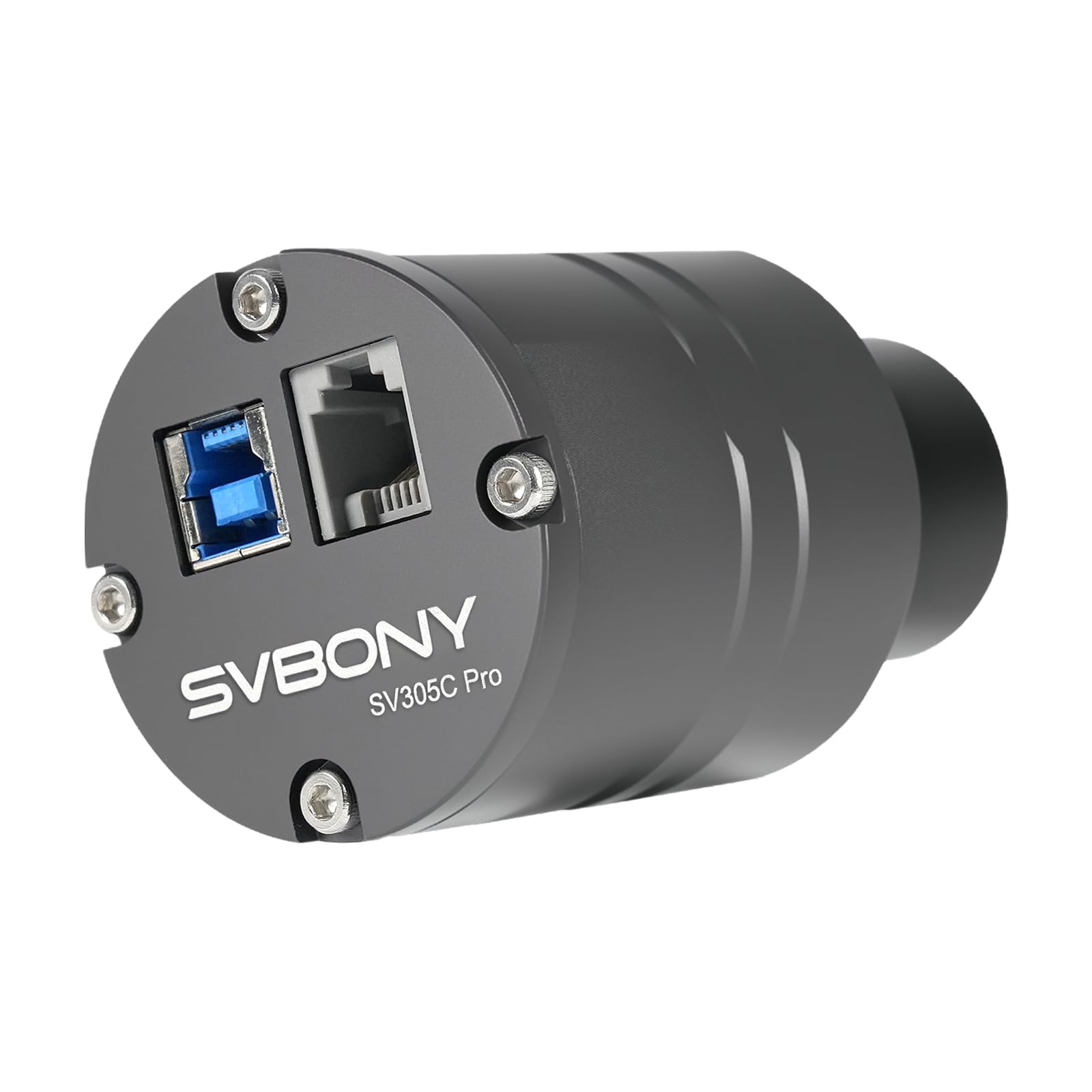
SVBONY SV305C Pro

85 /100
Studio Score Strong Evidence

Key details

Max Exposure
Software & OS
SharpCap, ASCOM, PHD2
Mount Standard
1.25-inch barrel
Sensor & Low Light
2MP IMX662 CMOS
Check Price on Amazon

The SV305C Pro pairs a 2MP IMX662 stacked CMOS sensor with USB 3.0 throughput and a 128MB buffer, capturing 1080p video at up to 107fps. The USB 3.0 interface moves those frames to a laptop without bottlenecking, and the ST4 port lets the same body serve as an autoguider, so one camera covers both planetary capture and guiding sessions. That places it a full step above the entry-level live-view scope camera in this set.

Readout noise around 0.7e- keeps individual frames clean, and the 128MB buffer helps the camera sustain long bursts without dropping frames during fast capture runs. The body feels solid on a telescope focuser, a practical advantage when swapping between a refractor and a guide scope. Those details matter more than the modest 2MP resolution.

Best suited to telescope owners running SharpCap or PHD2 on a Windows or macOS laptop; iPad-only users are out of luck. The 1.25-inch sensor is built for the Moon, planets, and EAA work, not wide-field deep-sky framing, so buyers with those goals should look at a larger-sensor camera. At a mid-range price, it becomes the single camera for planetary and guiding sessions.

💡 Install SharpCap and the ASCOM platform before connecting the camera to the mount.

Pros

  • Captures the Moon and planets at up to 107fps with clean, low-noise output.
  • Build quality stands out among small astronomy cameras, with a solid body that mounts cleanly on a focuser.
  • One camera serves as planetary imager and ST4 autoguider, removing the need for a separate guide camera.

Cons

  • SharpCap and ASCOM configuration takes time; first-time astro-imagers may spend an evening getting the driver chain working.
  • In certain mount and software pairings, ST4 guiding can be finicky and require extra calibration.
Our verdict

This is the right scope camera for planetary imagers who also want ST4 guiding without adding a separate guide camera.

Check Latest Price
5

Best Budget Telescope Camera

SVBONY SV105

82 /100
Studio Score Strong Evidence

Key details

Max Exposure
~0.5s
Software & OS
Windows, Android, macOS
Mount Standard
1.25-inch barrel
Sensor & Low Light
2MP IMX307 CMOS
Check Price on Amazon

The SV105 slides into a standard 1.25-inch focuser and shows the Moon and bright planets on a laptop screen within minutes. Windows and Android treat it as a UVC camera, so driver installation is not required for live viewing, and the M28.5 filter thread accepts common 1.25-inch eyepiece filters.

At 1920x1080 and 30fps, the live view is responsive enough to center targets and capture short video clips for stacking. The 2MP sensor gives a usable first look at Jupiter's cloud bands and Saturn's rings, and it doubles as a backup guide camera when autoguiding is the next step. Pairing it with free capture software like SharpCap lets a beginner record planetary video and stack frames into a cleaner image than a smartphone shot through an eyepiece.

This camera is for the beginner who owns a telescope with a 1.25-inch focuser and wants to learn planetary imaging without a large investment. The roughly half-second exposure ceiling keeps deep-sky galaxies and nebulas out of reach, and macOS/M1 support can be inconsistent; Windows and Android are the supported path. Because setup is simple, the learning curve stays focused on target acquisition and stacking rather than driver troubleshooting. For that buyer, the SV105 is the lowest-risk way to start.

Pros

  • Cost-effective first astro camera that puts lunar and planetary views on a laptop without a big investment.
  • The 2MP sensor is capable enough for starter planetary captures and backup guide duty.
  • UVC plug-and-play on Windows and Android means live viewing works with no driver download.

Cons

  • iOS devices are not supported, so an iPad-only setup won't see the camera.
  • Focusing can be tedious on some telescope tubes, and extra spacer length may be needed before the Moon comes to focus.
Our verdict

For the first-time telescope owner who wants to see the Moon and planets on a screen, this is the least risky way in.

Check Latest Price
6

Classrooms & Clubs

FIBONAX Nova200

81 /100
Studio Score Strong Evidence

Key details

Max Exposure
Software & OS
Windows, macOS, Linux
Mount Standard
1.25-inch barrel
Sensor & Low Light
2MP CMOS
Check Price on Amazon

The Nova200 is a 1.25-inch telescope camera built around live Moon-and-planet viewing. The clean UVC spec sheet is the main draw: Windows, macOS, and Linux support in a CNC-aluminum body with an optional ASCOM driver. Standard 1.25-inch filter threading means an IR-cut or color filter can be added without an adapter. The main reason it does not rank higher is that cheaper UVC cameras cover the same live-view role. For a classroom or club that wants a metal-bodied cross-platform option for bright targets, the Nova200 is a coherent package at an entry-level price.

Pros

  • CNC aluminum body keeps the camera light at 110g, a practical match for student-mounted telescopes.
  • Windows, macOS, and Linux support covers mixed-OS classrooms without extra software.

Cons

  • The 2MP 1080p sensor limits planetary close-up detail compared with higher-resolution planetary cameras.
  • Deep-sky imaging is outside its intended workflow, so faint nebulae and galaxies are not realistic targets.
Our verdict

For a classroom or astronomy club that wants a budget metal-bodied UVC camera for live Moon and planet sessions on mixed operating systems, the Nova200 fits when the session stays on bright targets.

Check Latest Price
7

Ultra-Budget Learners

Nikon D3100 (Renewed)

80 /100
Studio Score Strong Evidence

Key details

Max Exposure
30s, bulb
Software & OS
SD card, no driver
Mount Standard
Nikon F-mount
Sensor & Low Light
14.2MP DX CMOS
Check Price on Amazon

The lowest entry point to an optical-viewfinder Nikon F-mount DSLR in this group, the D3100 gives budget learners a real viewfinder and Nikon DX lens compatibility. It handles the Moon and brighter sky targets, making it useful for wide-field nightscape practice. The 14.2MP sensor and native ISO 3200 are a generation behind modern astro-capable bodies, though, and renewed-condition QC varies: non-functional units can arrive or stop functioning within weeks. This is why it sits as an also-consider rather than a top pick — a spare or practice body for Nikon shooters, not a single critical-duty astro camera.

Pros

  • The lowest entry cost into the Nikon F-mount interchangeable-lens system.
  • An optical-viewfinder body with good basic quality for budget learners.

Cons

  • The dated 14.2MP sensor and native ISO 3200 hold back faint deep-sky detail compared with current astro-capable bodies.
  • Renewed units can arrive non-functional or stop functioning within weeks; an astro night should not depend on this camera alone.
Our verdict

Budget Nikon shooters who want a practice body for lunar and wide-field nightscapes can make this work; critical deep-sky imaging needs a newer sensor.

Check Latest Price

How to Choose

Sensor Size and Low-Light Performance

Sensor area decides how many photons each exposure collects. A full-frame sensor gathers roughly 2.3 times the light of APS-C at the same aperture, which shows up as cleaner shadows and less noise at high ISO. The trade-off is size and cost: full-frame bodies and lenses are heavier and pricier.

Telescope-attached cameras use tiny sensors. A 1/2.8-inch chip is excellent for the Moon and bright planets, but it cannot integrate enough light for faint nebulas — no firmware update changes that physics. Match sensor size to the brightness of your target, not the marketing label.

Maximum Exposure Length

Exposure length is the hard boundary between planetary and deep-sky work. Faint galaxies emit so little light that a half-second capture sees almost nothing; they need 30-second or multi-minute exposures, tracked to prevent star trails.

Budget telescope cameras often cap out at half a second, fine for bright targets but unreachable for deep-sky. Check the camera's maximum exposure before buying — that number defines what the camera can ever photograph.

Frame Rate and Sensor Generation

Planetary imaging works by lucky imaging: shooting hundreds or thousands of short frames and stacking the sharpest. Higher frame rates freeze the brief moments when the atmosphere steadies, and newer stacked sensors cut readout noise.

The hidden requirement is data throughput. A 107fps camera produces video quickly, so it needs USB 3.0 and a computer that can write the stream without dropping frames. An older 30fps camera is still usable for the Moon, just less forgiving.

Mount Standard

The mount interface decides which equipment the camera can touch. A 1.25-inch barrel slides into a telescope focuser like an eyepiece; an interchangeable-lens camera needs a lens or T-ring adapter to reach prime focus.

The consequence is a narrow field of view. At common telescope focal lengths, the full Moon may overflow the frame, and users unexpectedly need a focal reducer. If you also want night landscapes, a lens-mount camera is the flexible route.

Software and OS Compatibility

Telescope cameras are controlled by capture software such as SharpCap, ASCOM, or PHD2, not by the camera itself. A capable camera is useless if its driver is unsupported on your operating system.

Windows is the safest ecosystem for astro cameras; macOS M1 and iPad support is inconsistent at this price level. Interchangeable-lens cameras avoid this entirely — images go to an SD card and open anywhere.

Frequently Asked Questions